Outdoor Kitchen Cabinets in Florida
August 19, 2026
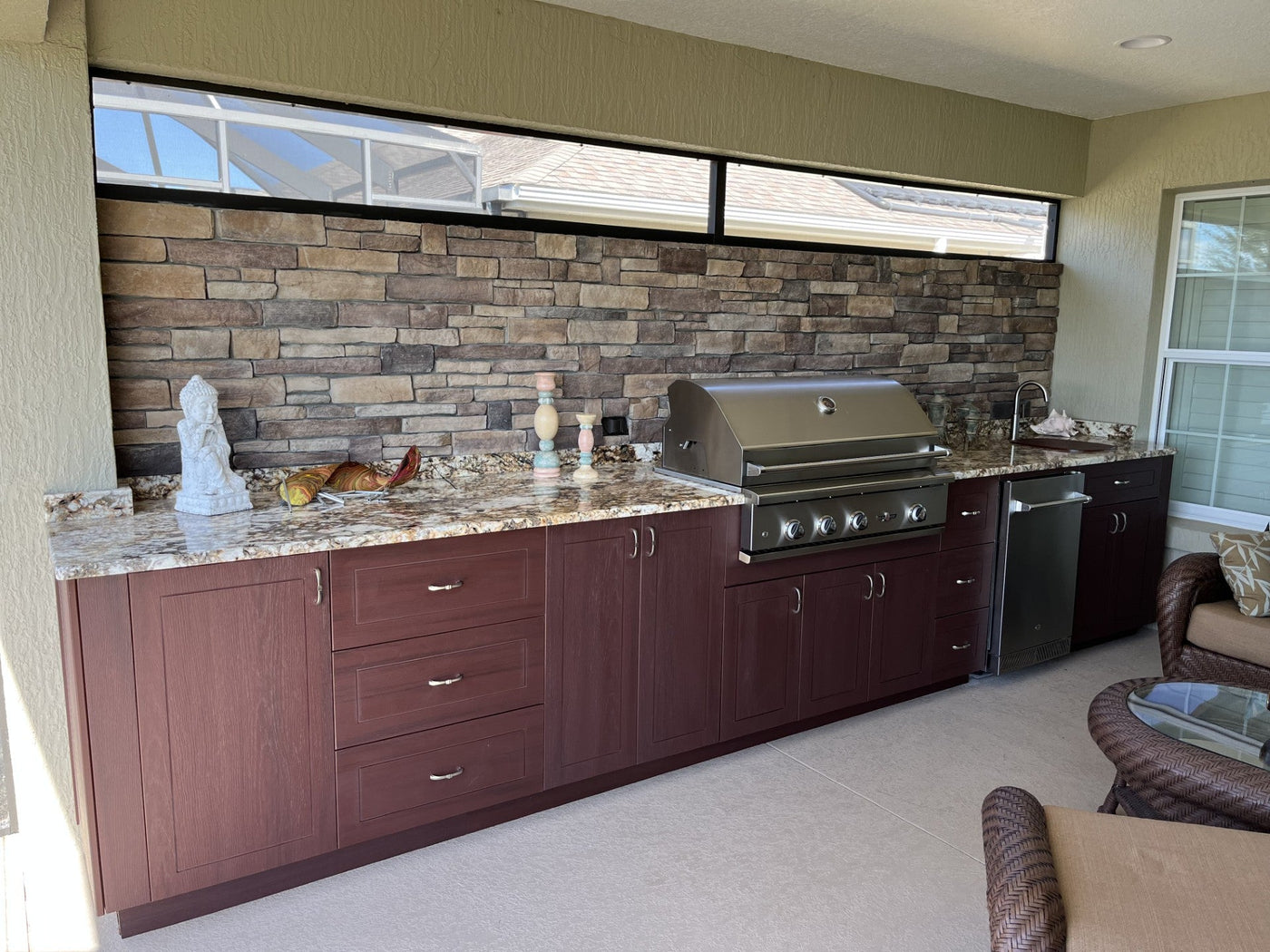
Key takeaways
Florida is harder on an outdoor kitchen than almost anywhere. Salt in the air, sun that does not let up, afternoon storms and humidity that never really leaves. We build in Homosassa, on the gulf coast, so this is the weather our cabinets were designed around rather than adapted to.
- Salt air is the deciding factor near the coast. It changes which stainless grade makes sense and how often you rinse.
- Ask what separates the stainless countertop from the metal frame under it. In salt air that joint matters.
- Expect water inside during a storm. What matters is whether the cabinet has a floor that manages it.
- Pool chemicals and outdoor kitchens share a patio. Some cleaners that live by the pool must never touch a cabinet door.
- Sun heats every countertop. A coated top runs cooler than bare metal, which is why every top we build is coated.
What Florida actually does to a cabinet
Heat, humidity and rain
Repeated wetting and drying swells anything wood-based, trapped humidity works on hardware and finishes, and direct sun heats cabinet faces and countertops, especially on a pool deck or a south-facing patio. An outdoor kitchen here has to be built for outdoor exposure, not adapted from an indoor cabinet.
Storms need a realistic plan rather than a promise. No outdoor cabinet is watertight, and heavy rain or wind-driven spray can put water in through door gaps. Every cabinet we build has an aluminum pan floor that closes out the bottom of each bay, so nothing sits on bare ground and water has somewhere to go instead of somewhere to sit. Aluminum and polymer do not rot or absorb moisture, so incidental water does not damage the structure. Keep moisture-sensitive things elsewhere, and wipe out standing water after a big rain.
Placement helps more than any feature. Try not to put the kitchen where roof runoff falls straight onto the doors, and never block a designed vent with storage or trim.
Salt air, and where it changes the answer
Salt is the demanding part, because deposits stay on metal surfaces and keep working. Two things follow from that.
First, the stainless grade. 304 is the standard for residential outdoor kitchens and it is what we build. Near the water it can develop what the trade calls tea staining, a light brown surface discolouration that is cosmetic and cleans off but keeps returning while the salt keeps landing. The stainless industry's own standards body recommends stepping up to the marine grade within a few miles of surf. If your house is on the Gulf or the Atlantic, ask about grade when you are getting quotes, because it genuinely changes the answer.
Second, and this is the one nobody asks: what sits between the stainless countertop and the metal frame underneath it. Stainless set straight onto an aluminum frame is what engineers call a galvanic couple, and salt air is exactly the condition where that starts to corrode. The military standard for joining dissimilar metals asks for a barrier between the surfaces and a seal against moisture. Our tops are bedded on silicone, which does both with one bead: it bonds the top down and keeps the two metals from ever touching.
Near salt water, add a fresh water rinse of the hardware to your routine and lubricate the hinges and slides more often than the usual two or three times a year.
Pool chemicals share the patio
This one is specific to how people live down here and it does not appear in most cabinet guides. Household bleach is actually the recommended treatment for a stubborn stain on King StarBoard ST doors. Pool chlorine is not. Never use 100 percent pool chlorine on a cabinet door, and keep chemical containers off the countertop and out of a closed cabinet where fumes can collect.
Materials, judged as a system
A cabinet can look substantial and still fail at its joints, edges or fasteners. Judge the whole assembly.
| Part | What it does | What to check |
|---|---|---|
| Welded aluminum frame | Carries the load without rust-prone steel | Whether it is welded or bolted, and whether you can see a photograph of it bare |
| Marine-grade HDPE doors | Takes the weather, colour through the sheet | Whether the colour is the material or a coating on it |
| 16 gauge 304 stainless top | Work surface and heat tolerance | The gauge, the support under it, and what separates it from the frame |
| Aluminum pan floor | Manages water that gets in | Whether the bays are closed out at the bottom at all |
| Hinges and slides | The only parts that need maintaining | Whether they are replaceable, and what the warranty says |
The frame
Ours are aluminum extrusion, cut to your build, squared in a jig and welded corner to corner into one rigid box in Homosassa. Not bracketed and not bolted, because a fastener in a structural joint is a hole and a moving part, and a cabinet in this climate runs a heat cycle every single day of its life. A weld cannot loosen; once it cools there is no joint left to loosen.
The frame ships bare aluminum, with bare pan floors and no coating at all. That is deliberate and it matters more here than most places: a coating is the only thing protecting a coated frame, and coatings fail first at cut edges and drilled holes, which is precisely where salt air gets to work. Bare aluminum grows its own oxide skin and grows it back every time it is scratched. You will never see the frame anyway once the doors go on. There is more on the reasoning on our how it's built page.
The doors
Marine-grade HDPE, coloured all the way through: King StarBoard ST in twelve solid colours, or SIMONA Polygrain in six embossed woodgrains. Nothing to seal, stain or refinish, which in this humidity is the difference between a kitchen and a maintenance project.
Every panel is screwed to the frame from the inside through oversized holes, which is what the sheet maker recommends and which lets the polymer expand and contract freely. Nothing is glued and no fastener shows on a face. It also means a deep scratch is a part rather than a repair: we ship you the panel and the instructions and the swap takes about twenty minutes with a screwdriver.
The countertop
16 gauge 304 stainless, powder coated grey or tan, both included at no extra cost. We do not offer bare stainless, and Florida is the reason. A coated top runs cooler in direct sun than bare metal and does not show every water spot. It still gets hot after an afternoon in full sun, so use judgement about what you set down.
The bare stainless you will have is on the Blaze appliances, and that is the surface that wants the classic treatment: wipe with the grain once cooled, dry it, and use a stainless conditioner now and then.
Planning a layout for a Florida yard
Measure the usable surface and the route
Record wall lengths, posts, steps, doors, gates, roof supports and the swing of nearby doors, then note where gas, electrical and water actually are. Then confirm a finished cabinet can travel from the street to its final position.
- Clear access width from the delivery point to the patio.
- Finished floor height, and any step or retaining wall in the way.
- Distance from the cooking zone to seating and to the property line.
- Where the outlets, shutoff valves, lighting and drainage are.
Tape the footprint out on the patio and leave it a few days. It tells you more than a drawing about whether the path to the pool or the back door still works.
Layout
A straight run suits a narrow patio or a simple grill station. An L adds preparation and storage while keeping one side open to guests. We build straight runs at 5, 6 and 7 feet and one L at 7 by 4. We do not build U-shapes, islands or freestanding modular pieces.
Think about where dirty dishes, drinks and platters will go, and keep seating outside the work zone. A shorter layout with clear circulation beats a longer one that blocks the route to the pool.
Slope, ventilation and clearance
Every appliance has its own required clearance and ventilation, and those come from the appliance instructions and local code rather than from a universal number. Never cover a vent or pack a cabinet so tightly that air cannot move.
For slope, check with a long level before ordering. Our cabinets ship with adjustable leveling feet giving up to 1.5 inches of adjustment, which handles most patios. Past that, the pad needs correcting rather than the feet.
Appliances and gas
Blaze, cut in before the frame leaves the jig
We fit Blaze only: grills, side burners and outdoor refrigeration. The 20 inch refrigerator is a BLZ-SSRF20-4.3 at 4.3 cubic feet. Every cutout is made for the appliance you chose before the frame is finished, so the cabinet and the cooking equipment arrive as one coordinated package.
Put refrigeration away from the hottest part of the run where you can, and check that drawers and doors open without hitting seating, a wall or each other. A trash slide-out and an LP tank slide-out are standard in every kitchen we build.
No insulated jacket
Worth asking any Florida maker, because it will not be in the cabinet quote. Put a grill inside a polymer box and the opening has to be lined with a metal jacket first, which is the polymer industry's own rule about its own material. That is $600 to $1,000 per grill.
Our grills drop straight in. The frame around the appliance is welded aluminum and the polymer is out on the door faces where the weather is, not wrapped around the appliance, so there is nothing combustible next to the fire to protect. Your appliance instructions always govern, and do not line the bay with foil or board, because anything added in there can block the ventilation the cabinet is designed around.
Natural gas or propane
Natural gas is convenient where a correctly sized line already exists and should be connected by a licensed plumber to meet local code. LP is more flexible, and the built-in tank slide-out is what gives you access for inspection and swapping. Either way, qualified installation is required for the Blaze warranty to be in effect. Tighten the LP regulator fitting with a wrench and leak test every joint with soapy water before lighting. If you ever smell gas, shut off the supply, ventilate, and call a professional rather than hunting for it.
Assembled, or built on site
Clarify what "custom" means in any quote, because it can mean a tailored layout, a made-to-order finish or a fully site-built masonry kitchen. Those are very different projects.
What fully assembled means here
Ours arrive as finished cabinets with the countertop already installed and the leveling feet fitted. Straight runs come as one piece and the L in two sections that bolt together on site. You place it, level it, and connect the gas. Most setups run under an hour once the pad is ready, and freight is free in the lower 48.
The trade-off is access, so measure the route and arrange help for positioning before the freight is scheduled.
Masonry, honestly
Masonry gives you architectural freedom and a permanent look, and if that is what you want then build masonry. What it costs you is flexibility: mortar and adhesive do not come apart later, and changing a grill in five years means cutting cured concrete in place. One maker publishes 906 lb for a seven foot island, which is also worth knowing before it goes on a deck.
What still needs a professional
A pre-assembled cabinet removes most of the site work but not all the responsibility. Natural gas belongs with a licensed plumber, electrical may need a qualified electrician or a permit, and pads, drainage corrections and grading deserve experienced help. Ask for a written division of responsibilities before ordering: site preparation, freight, placement, gas, electrical and final inspection.
Cost, warranty and living with it
What moves the price
Size, layout, finish, countertop, appliance package, accessories and the delivery conditions. A small straight run is far simpler to deliver than a multi-section run, and a difficult site adds cost even when the cabinet does not change.
Ours start at $6,774 for a straight run and $8,474 for the L, complete with the powder coated countertop and free freight in the lower 48. Our configurator prices layout, size, door finish, countertop, appliances and accessories live as you change them, with no email required. Treat that as the product cost and confirm site and utility work separately. The cost guide covers where the rest of the money goes.
The warranty, in plain terms
Read the cabinet and appliance warranties as separate documents, and read the exclusions rather than the headline. Ours: we do not cover fading, because nothing anyone sells can honestly promise a colour will never shift in Florida sun, and we would rather say that than write a sentence we cannot stand behind. What we do not do is rule out corrosion altogether, which some of the biggest names in this category do in writing. The exception is hardware that never got maintained.
Blaze appliances carry their own warranty with a deadline worth knowing before delivery: register each appliance at blazegrills.com within 30 days of purchase and keep the receipt. Blaze covers main burners, cooking grids, body, flame tamers, warming racks and valves for life, and ignition and electronics for a year. It does not cover discolouration or surface rust.
A Florida routine
- Wipe cooking residue off once things have cooled, before the sun bakes it on.
- Wipe out standing water after a heavy storm and check the vents are clear.
- Rinse hardware with fresh water if you get salt spray.
- Clean stainless with the grain and dry it, to keep water spots and tea staining down.
- Silicone spray on hinges and slides two or three times a year, more often near the water.
That last one is the only job on the list with consequences. Left dry, hinges and slides corrode, stiffen and eventually seize, and no warranty covers neglected hardware. Our protection guide has the full routine.
Built here, for here
We are Aluminum Outdoor Kitchens LLC, in Homosassa on the gulf coast. We weld the frames, cut the poly and crate every cabinet ourselves, and we own the building. There is no call centre and no sales team, which is either the reason to buy from us or the reason not to, and we would rather you decided having spoken to us. Call 352-450-8881, Monday to Friday, 8am to 4pm Eastern, or email info@fireislands.com.
Conclusion
A Florida outdoor kitchen comes down to salt, sun, storms and the joints where materials meet. Ask about the stainless grade for your distance from the water, ask what separates the top from the frame, ask whether the grill needs a jacket, and make sure the cabinet has a floor that deals with the rain that will get in. Get those right and the kitchen just works, through long summers and sudden afternoons.
Frequently asked questions
What cabinet material is best for Florida weather?
A welded aluminum frame carrying the load with marine-grade HDPE on the outside taking the weather. That way each material does one job. Watch the joints as closely as the materials, especially where stainless meets aluminum in salt air.
Are outdoor kitchen cabinets waterproof?
No outdoor cabinet is watertight, and heavy rain here will find a door gap. The useful question is where the water goes: ours have an aluminum pan floor that closes out each bay so it does not sit on the patio or pool inside.
Do I need 316 stainless if I live on the coast?
Within a few miles of surf it is worth asking about, which is what the stainless industry's own guidance suggests. Further inland, 304 with a regular wipe-down is the balanced choice, and it is what we build.
Do outdoor kitchen cabinets need to be covered?
Not required, but shelter reduces sun, wind-driven rain and salt, and it will keep the finish looking new for longer. Even a covered kitchen still wants routine cleaning near the coast.
Can I use pool chemicals near the cabinet?
Keep them off it. Household bleach is fine on a StarBoard ST stain, but never use 100 percent pool chlorine on a cabinet door, and do not store chemical containers in a closed cabinet where fumes can collect.
How much clearance does a built-in grill need?
It depends on the model, the surrounding materials and local requirements, so follow the appliance instructions rather than a universal figure, and keep combustible material away from the heat.
Can an outdoor kitchen go on an uneven patio?
Modest slopes are handled by the adjustable feet, up to 1.5 inches on ours. A badly uneven, unstable or poorly drained surface should be corrected before the cabinet arrives.
Is natural gas or propane better here?
Natural gas if a properly sized line already exists; propane if not, with the tank in the built-in slide-out for access. Both need the right equipment, ventilation and qualified connection work.
Keep reading
Build the one you have been reading about.
Layout, finish, appliances and a live price. Ships fully assembled, free in the lower 48.
Start your build →