Outdoor Kitchen Replacement Cabinets
August 19, 2026
Key takeaways
- Most outdoor cabinets fail at the box, not the doors. A welded aluminum frame removes the part that rots or rusts.
- Measure the old footprint, the finished counter height and every appliance cutout before you order anything.
- Our replacements ship fully assembled with the countertop installed, in a straight run or an L-shape.
- Marine-grade polymer doors are colored through, so a scratch does not expose a different material.
- Read the warranty exclusions as closely as the coverage. Weather and installation are where most claims fail.
Why outdoor kitchen cabinets get replaced
Almost nobody replaces outdoor cabinets because they got bored of the color. They replace them because the boxes gave up. Marine plywood swelled at the toe kick. A steel frame rusted through where the powder coat got chipped. A masonry island cracked along a seam and started holding water. The doors usually look fine. It is the structure underneath that failed.
That is worth naming clearly, because it changes what you should be shopping for. You are not buying doors. You are buying the box.
Working out what actually failed
Before you order anything, find out what went wrong. Open every door and look at the corners, the floor and the back panel. Press on the bottom of the cabinet near the front edge. If it flexes or feels soft, the material has absorbed water. Look for rust bleeding out from fastener heads, which usually means the frame is steel and the coating is compromised.
Then look at drainage. If water pools against the base after rain, or if roof runoff lands directly on the doors, whatever you put there next will be fighting the same conditions. Fixing the drainage is cheaper than replacing a second kitchen.
Measuring before you order
Do not assume a new cabinet opening matches an older grill or refrigerator. Use the appliance manufacturer's cutout dimensions rather than the visible face measurements, and allow for trim, brackets, gas connections, electrical cords and service access. Check countertop thickness and overhang too, since those affect the finished height and how appliances sit in the run.
Write down four numbers before you do anything else:
- The overall length of the existing run, corner to corner.
- The finished countertop height from the patio surface.
- The cutout width and depth for every appliance you are keeping.
- The narrowest point on the route from the street to the patio.
Materials built for year-round outdoor use
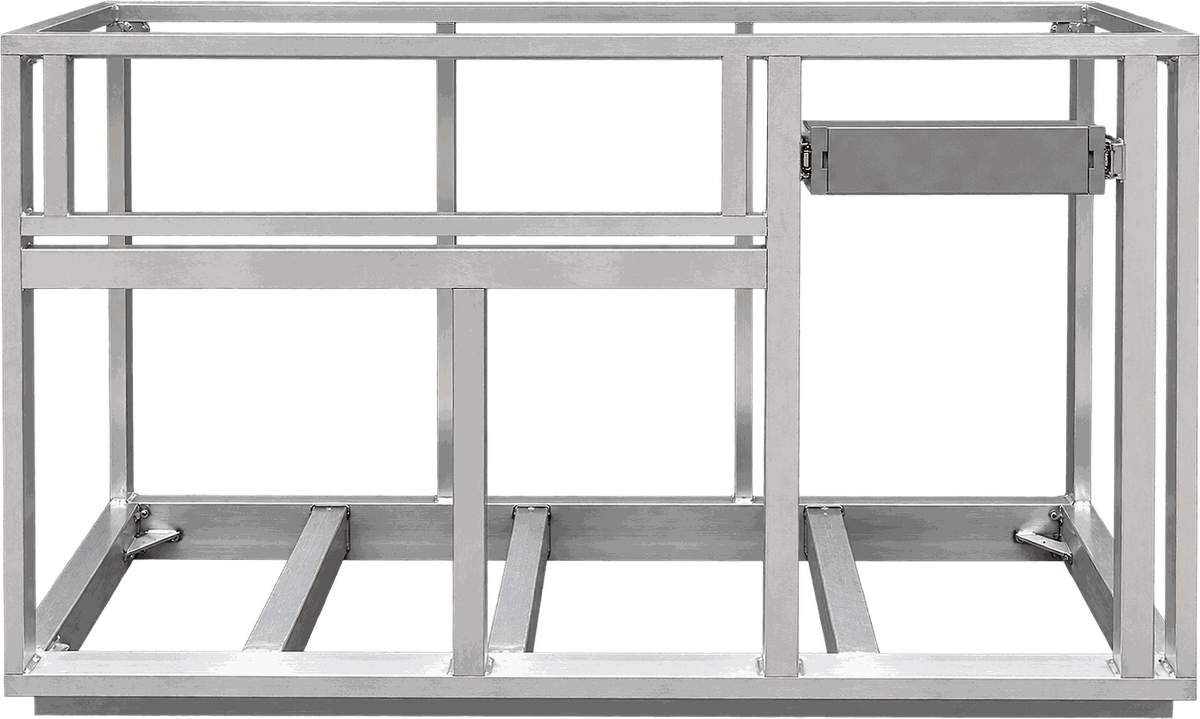
A welded aluminum frame gives you a rigid cabinet box without relying on wood that can absorb water or steel that can rust once its coating is damaged. The frame still needs sound fabrication and proper leveling, but aluminum is a sensible foundation for a kitchen exposed to rain and humidity. In coastal areas, rinse salt residue away regularly even when the main structure is corrosion resistant.
We build on a welded aluminum frame with marine-grade polymer doors. It will not rust, rot or warp. If the reason you are replacing a run is that the old boxes swelled, delaminated or rusted through at the corners, that is exactly the problem this construction was picked to solve.

Marine-grade HDPE and polymer doors compared with wood
Natural wood can look beautiful outdoors and it will ask you for a sealing and refinishing program forever. Composite products vary widely: some are engineered for exterior use, others have layers or cores that fail quickly once water reaches an edge.
Our doors and drawers are marine-grade polymer. King StarBoard ST in twelve solid colors, and SIMONA Polygrain in six woodgrains: Birch, Olyphant Oak, Teak, Susquehanna Grey, Northeastern Walnut and Onyx. Both polymers are made for permanent outdoor exposure, and both are colored all the way through, so a scratch does not expose something different underneath. Both want mild soap, a soft cloth and a little attention to the specific finish.
304 stainless countertops
304 stainless steel is used wherever a surface needs strength, cleanability and resistance to ordinary outdoor moisture. It gives the kitchen a continuous professional look and avoids the rot and delamination that come with less suitable countertop materials.
We build every countertop from 16-gauge 304 stainless, powder coated in grey or tan. There is no upcharge for either, and we do not ship bare stainless. Direct sun will heat any metal surface, coated included, so take care with hands, food and cookware on a counter that has been sitting in it.
How heat, UV, moisture and humidity affect materials
Sunlight fades poor finishes, dries some materials out and accelerates failure in anything not chosen for exterior use. Marine-grade polymers are selected because they hold their shape, color and finish under UV, humidity and water. Aluminum stays stable through normal temperature swings. None of that removes the need for shade, airflow and sensible placement, which extend the life of every outdoor surface.
Choosing a layout for the replacement
A replacement is a rare chance to fix a layout that never quite worked. If you always found yourself carrying plates across the grill, or if the fridge door opened into the walkway, now is when that gets solved.
Straight runs
A straight run is the simplest arrangement and works well against a wall or along a patio edge. It keeps the delivery simple, it keeps the footprint honest, and it is what most replacements end up being, because most failed kitchens were straight runs in the first place. We build them in 5, 6 and 7 feet.
L-shapes
An L-shaped arrangement turns a corner into useful work space and naturally separates cooking from prep or serving. One leg holds the grill and burners while the other provides landing space, drawers and refrigeration. It also gives guests a clearer place to gather without standing directly in front of the hot zone. Ours is 7 by 4.
Check the inside corner carefully. Doors and drawers on adjoining sections need enough clearance to open together. The longer leg should not block a walkway or make the patio feel pinched.
Replacing a run that has failed
Our frame is welded as one piece, so a replacement is measured against the footprint of the old kitchen rather than assembled around it. Get the length of the existing run, the finished counter height, and the cutout sizes for every appliance you plan to keep. If the old cabinets were built on site and the footprint is odd, tell us before you order rather than after.
A welded box also means the replacement will not develop the same problem again. There is nothing in it to swell, and nothing bolted together that can work loose over ten summers.

Real cabinet from our shop, color and setting enhanced with AI.
Appliances, storage and ventilation
Built-in grills and burners need precisely sized openings, support surfaces and room for connections behind or below the appliance. Refrigerators need a clean flush fit and enough access for the door to open fully. Never size an opening from a product photograph. Use the current manufacturer's installation drawing.
We fit Blaze grills, side burners and outdoor refrigeration, and we cut the openings for them. On a replacement project, send us the models you are keeping and the ones you are changing, and we will confirm every cutout before anything goes into production.
Drawers, doors and waste storage
Storage should follow the work zones. Grilling tools near the grill, platters near the prep surface, seasonings where you can reach them without crossing hot equipment. Trash and LP tank slide-outs come standard in every kitchen we build, which handles the two compartments people most often forget to plan for.
Keep moisture-sensitive supplies out of an outdoor cabinet entirely, and never pack storage against a vent.
Ventilation
Ventilation is a safety feature. Do not cover the openings, do not block them with stored items, and do not seal an enclosure in a way that stops airflow. Appliance instructions and local code determine what a particular installation needs.
Delivery and installation
What fully assembled means
A fully assembled cabinet arrives as a finished unit rather than a collection of panels and hardware. We ship fully assembled with the countertop installed. A straight run arrives as one welded piece and an L-shape in two sections that bolt together on arrival. Adjustable feet give you up to 1.5 inches of leveling on an uneven patio.
The practical work at your end is positioning, leveling, fitting appliances and completing approved utility connections. Freight is included across the contiguous United States.
Removing the old kitchen first
Have the old cabinets out and the pad clear before the delivery appointment. If the previous run was masonry, the demolition and the disposal are a bigger job than the installation of the new one, and a skip in the driveway on delivery day helps nobody. Check the slab underneath once it is exposed. A pad that was hidden under a cabinet for a decade sometimes has surprises.
Gas connections
Gas work is where a simple cabinet setup becomes regulated installation work. Natural gas lines should be installed and inspected by a licensed plumber. All appliance gas installations should be completed by a qualified installer so local codes and applicable warranties are respected. LP systems deserve qualified inspection too, particularly when the cylinder, regulator or hose arrangement is unfamiliar.
You can generally place and level the assembled kitchen yourself. The gas hookup is the part to hand over. Treat any odor, damaged fitting or uncertain connection as a reason to shut off the supply and call a technician rather than troubleshooting by guesswork.
Finishes, value and warranty
Choosing finishes
Solid-color polymer doors create a crisp, consistent look and coordinate easily with stainless steel. Woodgrain polymer offers visual warmth through an embossed surface while avoiding the staining and sealing that natural wood demands. Ask how each finish should be cleaned and what heat, solvents and abrasives will damage it.
On the countertop, grey reads cooler and more utilitarian. Tan warms the run up and sits better beside brick, travertine and wood furniture. A fire table can match the kitchen finish or deliberately break from it, and either works, but give it room for seating and safe access rather than placing it for symmetry.
Comparing standard sizes with custom work
Standard sizes simplify pricing, production and replacement planning. They work well when the patio has open edges and common appliance dimensions, which describes most replacement projects.
If your project needs more than cabinets, countertops beyond the stainless top, appliances beyond Blaze, stone, plumbing or a full install, call us. We will work out what you need and hand you to one of our preferred dealers in your area. They design, quote, build and install. We build the cabinets and warranty them. There is more on the custom page.
The warranty
We back our cabinets with a limited lifetime residential warranty against defects in materials or workmanship, for the original purchaser, under normal residential use and subject to the stated terms. It excludes labor and shipping.
Appliances, countertops, hinges, slides and leveling parts may carry separate manufacturer coverage, and Blaze warranties the major components of their grills for life under their own terms. Weather damage, misuse, neglect, modification and improper installation generally fall outside cabinet warranty coverage anywhere you buy. Keep your proof of purchase, photograph any issue, and keep records of qualified gas work with the purchase documents.
Conclusion
Replacing outdoor cabinets is a chance to remove the failure rather than repeat it. Find out what actually went wrong, fix the drainage while the pad is exposed, measure the footprint and every appliance cutout properly, and pick a box built from materials that cannot rot or rust. Do that and the second kitchen outlasts the first by a long way.
Price a replacement in the configurator, or read the cost guide for what else belongs in the budget.
Frequently asked questions
Can I replace just the doors?
Sometimes, but it is usually the wrong repair. Doors are rarely what failed. If the box has absorbed water or the frame has corroded, new doors sit on a structure that is still going.
Will a new cabinet fit my existing appliances?
Usually, provided you work from the appliance manufacturer's cutout drawings rather than the visible face. Send us the model numbers and we will confirm the openings before production.
What layouts do you build?
A straight run in 5, 6 or 7 feet, and an L-shape at 7 by 4. We do not build U-shapes or freestanding modular pieces.
Do I need to remove the old kitchen before delivery?
Yes. Have the pad clear and accessible before the freight appointment, and check the slab once it is exposed.
Is shipping included?
Yes, across the contiguous United States.
How level does the patio need to be?
The adjustable feet handle up to 1.5 inches of variation. Beyond that, the base should be corrected before delivery.
What does the warranty cover?
Defects in materials or workmanship under normal residential use, for the original purchaser, subject to the stated terms. Labor and shipping are excluded, and appliances carry their own manufacturer coverage.
Keep reading
Build the one you have been reading about.
Layout, finish, appliances and a live price. Ships fully assembled, free in the lower 48.
Start your build →