How to Choose Outdoor Kitchen Cabinets
August 19, 2026
Key takeaways
Nearly every outdoor kitchen sold in this country is built one of five ways. They are genuinely different products, and the difference has nothing to do with door colour.
- Work out which of the five construction types you are looking at before you compare anything else.
- Ask what carries the countertop. If the panels are the structure, the panels are doing two jobs at once.
- Ask whether the grill needs an insulated jacket. That is $600 to $1,000 that never appears in a cabinet quote.
- Measure the delivery path, not just the pad.
- Price the whole project: freight, appliances, gas work, pad, and what it costs to live with.
The five ways to build an outdoor cabinet
Start here, because everything else follows from it. We build one of these five and we will say plainly where the others are the better answer.
1. All polymer, with no frame inside
Thick polymer panels are the structure. Nothing to rot or rust, colour runs all the way through, and most arrive assembled. The catch is that one panel is doing two jobs at once, skin and structure, so the same piece has to carry the countertop, take the weather and absorb its own movement at the same time. It is also why a grill in one of these needs an insulated jacket first.
2. Coated core: PVC or treated wood fibre
A painted and lacquered face over a PVC or wood-fibre core. The best wood look in the business, by a distance. The colour is a finish rather than the material, so a chip shows what is underneath and a deep scratch cannot be sanded out at all. The cores also soften at lower temperatures than polymer does, so grills here need jacketing too.
3. Concrete and masonry
Permanent, and heavier than the brochures suggest. One maker publishes 906 lb for a seven foot island and 2,495 lb for an L-shape, which is worth knowing before it goes on a deck. Panels carry through a gate, which is a real advantage. But mortar and adhesive do not come apart later, and changing a grill means cutting cured concrete in place.
4. Stainless steel, 304 or 316
The premium tier and a beautiful material. Near the coast it develops what the trade calls tea staining, which is cosmetic and cleans off, though the stainless industry's own standards body recommends the upgraded grade within a few miles of surf. Worth reading the finish warranty rather than the web page.
5. Welded aluminum frame with polymer doors
This is ours. Aluminum carries the load, polymer takes the weather. Each material does the one job it is good at, instead of one material doing both because it is the only material in the building.
And we are not against any of the others. Two of them would be a better choice than us for some jobs: if you want a permanent masonry island, build masonry, and if you want mirror polished stainless, we do not make it. What we would argue about is how the fifth one compares with the first two.
How much the material has to move
Everything grows and shrinks as it heats and cools, and polymer does far more of it than metal. This one table explains most of why outdoor cabinets are built the way they are.
| Material | How much it moves | Across a 7 foot run | Softens or limits at |
|---|---|---|---|
| Concrete | 5.5 | 0.05 in | no practical limit |
| 304 stainless | 9.6 | 0.09 in | no practical limit |
| Aluminum | 13.1 | 0.13 in | no practical limit |
| PVC core | about 30 | 0.29 in | around 149°F |
| HDPE polymer | 61 to 72 | 0.63 in | 180°F |
Our doors are polymer too, so they move as much as anyone's. The question is never whether a material moves. It is whether the cabinet was built to let it. The sheet maker's own guidance is to fasten mechanically through oversized holes and not to glue, which is exactly what we do: every panel screwed to the frame from the inside, nothing bonded, no fastener showing on any face.
Questions that separate cabinets quickly
Is the frame welded, or fastened?
An aluminum frame that bolts together has a fastener in every structural joint. A cabinet on a patio runs a heat cycle every day of its life, expanding through the afternoon and contracting overnight, and before any of that it spends days on a freight truck. Fasteners are the part that answers to all of it.
Ours are welded corner to corner into one rigid box, squared in a jig in our shop. A weld cannot loosen, because once it cools there is no joint left to loosen. Ask any maker for a photograph of the bare frame and see what comes back. Ours is on the how it's built page.
Does the grill need an insulated jacket?
Put a grill inside a plastic box and the opening has to be lined with a metal jacket first. That is not our claim about anyone else's cabinets, it is the polymer industry's rule about its own material: marine polymer softens around 180 degrees and a grill runs several hundred. One maker states plainly that a jacket is needed for safety if the kitchen is built from wood, PVC or HDPE. Another voids its warranty outright if a heat appliance goes in without one.
A jacket runs $600 to $1,000 per grill. Ours drop straight in: the frame around the appliance is welded aluminum and the polymer is out on the door faces where the weather is, not wrapped around the appliance, so there is nothing combustible next to the fire to protect. Your appliance instructions still govern.
What happens if I scratch a panel in five years?
On most cabinets you live with it, because when the panel is the structure a damaged panel is a structural problem. On a painted or lacquered face the colour is a coating, so a deep scratch cannot be sanded out, and at least one maker voids the warranty if you touch it up yourself.
Ours are screwed on from inside, so a damaged panel is a part. We ship you the panel and the instructions and you are done in about twenty minutes with a screwdriver. Both our sheet materials are coloured all the way through, so most marks do not show in the first place.
What is between the stainless top and the metal underneath?
A stainless countertop set straight onto an aluminum frame is what engineers call a galvanic couple, and in salt air it is how aluminum starts to corrode. Ours are bedded on silicone, which bonds the top down and keeps the two metals from ever touching. Ask anyone else what sits in that joint.
Start with the space you actually have
Climate and exposure
Coastal air accelerates corrosion, hard sun heats and fades surfaces, and freeze-thaw stresses anything poorly chosen. Ask what care a finish needs after a season of real exposure rather than how it looks on delivery day. And remember that weather-resistant is not watertight: any outdoor cabinet can take some water in through door gaps during heavy rain, which is why ours have an aluminum pan floor to give it somewhere to go.
Measure the usable area, then the route
Record width, depth, doors, roof posts, steps, walls and the clearance needed to open appliance doors and drawers. Leave room behind the cook for someone to pass without brushing a hot surface. Then measure the delivery path, because a kitchen that fits the pad can still be impossible through a side gate.
Mark the footprint on the patio with tape and leave it for a few days. That single test tells you more than a drawing about whether the design feels generous or crowded.
Layout
A straight run works against a wall or along a narrow edge. An L creates a corner that separates preparation from cooking and gives guests somewhere to stand. We build straight runs at 5, 6 and 7 feet and one L at 7 by 4. We do not build U-shapes, islands or freestanding modular pieces, and we would rather tell you that than quote something we do not make.
Think about conversation as well as workflow. If people gather near the kitchen, position the grill so the cook is part of it rather than a traffic obstacle.
Slope
Check the slope with a long level before ordering, because a sloped pad leaves doors misaligned and countertops visibly off. Our cabinets ship with adjustable leveling feet giving up to 1.5 inches of adjustment. Beyond that a slope may affect level installation, and the pad needs addressing rather than the feet.
Appliances, and letting them lead
Cabinets should follow your cooking routine. Think through a normal meal: where ingredients are stored, where food is prepared, where hot food lands, where serving dishes wait. A compact kitchen with useful counter space beats a long one full of features you never touch.
The grill
Start here, because it is the most demanding thing in the plan. Consider how many people you cook for, whether you use indirect heat, and how much landing space you need either side. Check burner access, hood clearance and the fuel connection against the manufacturer's instructions.
We fit Blaze only, and every cutout is made for the appliance you chose before the frame leaves the jig. That removes the guesswork from cutout dimensions, but the installation still has to follow the appliance requirements and local codes.
Side burner
Worth it if you regularly make sauces, boil water or want a pan outside, because it saves trips indoors during a long meal. If your outdoor cooking is occasional grilling, the counter space may be worth more. We offer both a drop-in single and a slide-in double; the slide-in consumes one drawer, which is worth knowing before you choose.
Refrigeration
Check capacity, door swing, ventilation clearance, electrical requirements and that the unit is actually rated for outdoors. A refrigerator packed into a cabinet without the required airflow will not perform as intended.
Ours is the Blaze 20 inch, model BLZ-SSRF20-4.3, at 4.3 cubic feet, sized to sit flush in the cabinet. Actual dimensions are 33 1/8 tall by 20 5/8 wide, in a cutout of 34 1/8 by 21 1/2.
Storage and accessories
Prioritise what you reach for while cooking, then keep one clear stretch of counter for setting down hot pans and plating. Too many accessories eat the work surface. A trash slide-out and an LP tank slide-out are standard in every kitchen we build. Our configurator prices layout, finish, countertop, appliances and accessories live as you change them, which makes the trade-offs easy to see before you order.
Assembled or flat-packed
What a flat-pack kit is
Separate panels, brackets, hardware and instructions, and the final fit depends partly on how accurately you assemble it. It can suit a careful builder with tools, time and a level workspace. Before choosing it, ask who handles a damaged part, how long assembly really takes, and whether the finished structure needs anchoring or other site work.
What factory assembly buys
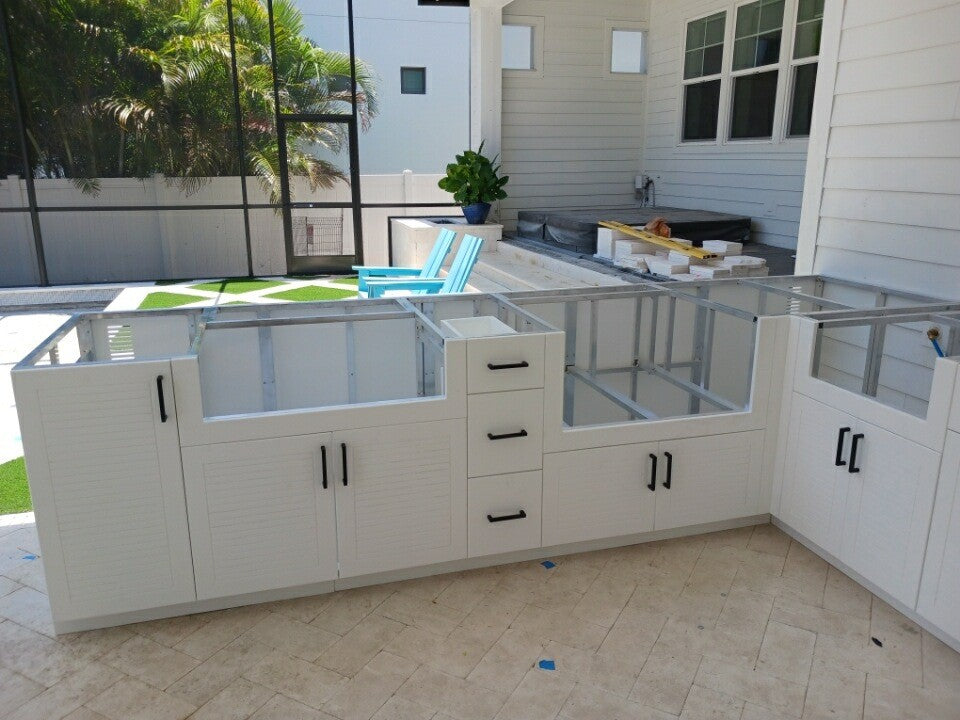
Consistent alignment between frame, doors, drawers, countertop and appliance openings, set in a shop rather than on a patio in the weather. Ours arrive as finished cabinets with the countertop installed. Straight runs come as one piece and the L in two sections that bolt together on site.
The trade-off is access. A finished unit needs a clear path and enough people to position it safely, so measure gates, paths, steps, turns and overhead obstructions before the freight is scheduled. Once the pad is ready and the gas is arranged, placing and levelling usually takes under an hour. Freight is free in the lower 48.
Where a professional is required
Gas is the point where convenience should not win. Natural gas should be connected by a licensed plumber, and qualified installation is required for any gas appliance for the Blaze warranty to be in effect. LP is more straightforward but still needs care: tighten the regulator fitting with a wrench and leak test every joint with soapy water before lighting.
Durability, safety and upkeep
Ventilation
Cabinet vents must stay clear. Do not pack storage against an opening, do not cover one with decor, and do not line the appliance bay with foil or board. Heat and gas accumulation is the reason those openings exist.
Cleaning, briefly
Mild dish soap, warm water and a soft cloth are the starting point for polymer and woodgrain, working along the grain on embossed faces. Avoid abrasive pads, steel wool, harsh solvents and close-range pressure washing on door faces. Stainless wants wiping with the grain and drying afterwards. Powder coated tops want gentle soap and water rather than polishing.
The one job with consequences
The hinges and drawer slides are the only parts that will fail if ignored. They are metal, they live outdoors and they have moving faces, and left dry they corrode, stiffen and eventually seize. A silicone spray two or three times a year is the whole job, more often near salt water. No warranty covers hardware that never got maintained, ours included. Our protection guide has the full routine.
Budget and warranty
Price the project, not the cabinet
Include appliances, the countertop, freight, pad preparation, gas and electrical work, accessories, an insulated jacket if the cabinet needs one, and ongoing care. Comparing sticker prices makes an apparently cheap option surprisingly expensive.
Ours start at $6,774 for a straight run and $8,474 for the L, complete with the powder coated countertop and free freight in the lower 48. Our cost guide shows where the money goes across the whole category.
Read both warranties
Cabinet and appliance warranties are separate documents. Check duration, who is covered, whether it transfers, and whether labour and freight are excluded. Then read the exclusions, because that is where the position actually is.
Ours plainly: we do not cover fading, because nobody selling a colour can honestly promise it will never shift in Florida sun. What we do not do is rule out corrosion altogether, which some of the biggest names in this category do in writing. The exception is unmaintained hardware.
Blaze appliances have their own terms and one deadline worth knowing early: register each appliance at blazegrills.com within 30 days of purchase and keep the receipt. Blaze covers main burners, cooking grids, body, flame tamers, warming racks and valves for life, and ignition and electronics for a year. It does not cover discolouration or surface rust.
Standard or custom
A standard size is the right answer when your patio has a straightforward footprint, and it simplifies pricing, ordering and delivery. Custom becomes reasonable with unusual dimensions, a complex slope, or a need to coordinate with an existing bar or fire feature. Our custom page explains how that works.
Conclusion
The best outdoor kitchen cabinets are not the largest or the most elaborate. They are the ones built the right way for where you live and the way you cook. Work out which of the five construction types you are looking at, ask what carries the countertop, ask whether the grill needs a jacket, and measure the route the cabinet has to travel. Those four things will narrow the field faster than any feature list.
Frequently asked questions
What material is best for outdoor kitchen cabinets?
There is no single answer for every site, but the more useful question is how the materials are combined. A welded metal frame carrying the load with polymer on the outside taking the weather asks each material to do one job. An all-polymer box asks one material to do both.
Are outdoor kitchen cabinets waterproof?
Weather-resistant rather than watertight. Heavy rain can put some water in through door gaps, so what matters is whether the cabinet has a floor that manages it. Do not store moisture-sensitive things inside.
Does an outdoor kitchen grill need an insulated jacket?
If polymer or a coated core surrounds the appliance opening, usually yes, and several makers require one in writing. Budget $600 to $1,000 per grill. On a welded aluminum frame with the polymer out on the door faces, there is nothing combustible next to the appliance and no jacket is needed.
How much clearance does an outdoor kitchen need?
It depends on the appliances, the fuel, nearby walls and roof structures, and local code. Allow for appliance doors, drawers, ventilation, safe cooking and someone passing behind the cook. Tape the footprint out on the patio before you commit.
Is stainless steel a good outdoor countertop?
Yes: durable, nonporous and easy to clean. 304 suits most residential sites, with the upgraded grade worth considering within a few miles of surf. We powder coat every top grey or tan at no extra cost and do not offer bare stainless, because a coated top runs cooler in the sun and shows fewer marks.
Do outdoor kitchen cabinets need ventilation?
Yes, particularly around gas appliances and enclosed compartments. Follow the appliance instructions and local requirements, and never cover or obstruct a designed vent.
Can I install an outdoor kitchen myself?
A pre-built cabinet can be positioned and levelled by a homeowner once the pad is ready. Gas connections should be completed by a licensed plumber or qualified installer, which is also a condition of the appliance warranty.
What should an outdoor kitchen budget include?
Cabinets, appliances, countertop, accessories, freight, pad preparation, gas and electrical work, installation help, permits where required, and ongoing care. The full project cost is the only fair basis for comparing two quotes.
Keep reading
Build the one you have been reading about.
Layout, finish, appliances and a live price. Ships fully assembled, free in the lower 48.
Start your build →