How to Protect Outdoor Kitchen Cabinets
August 19, 2026
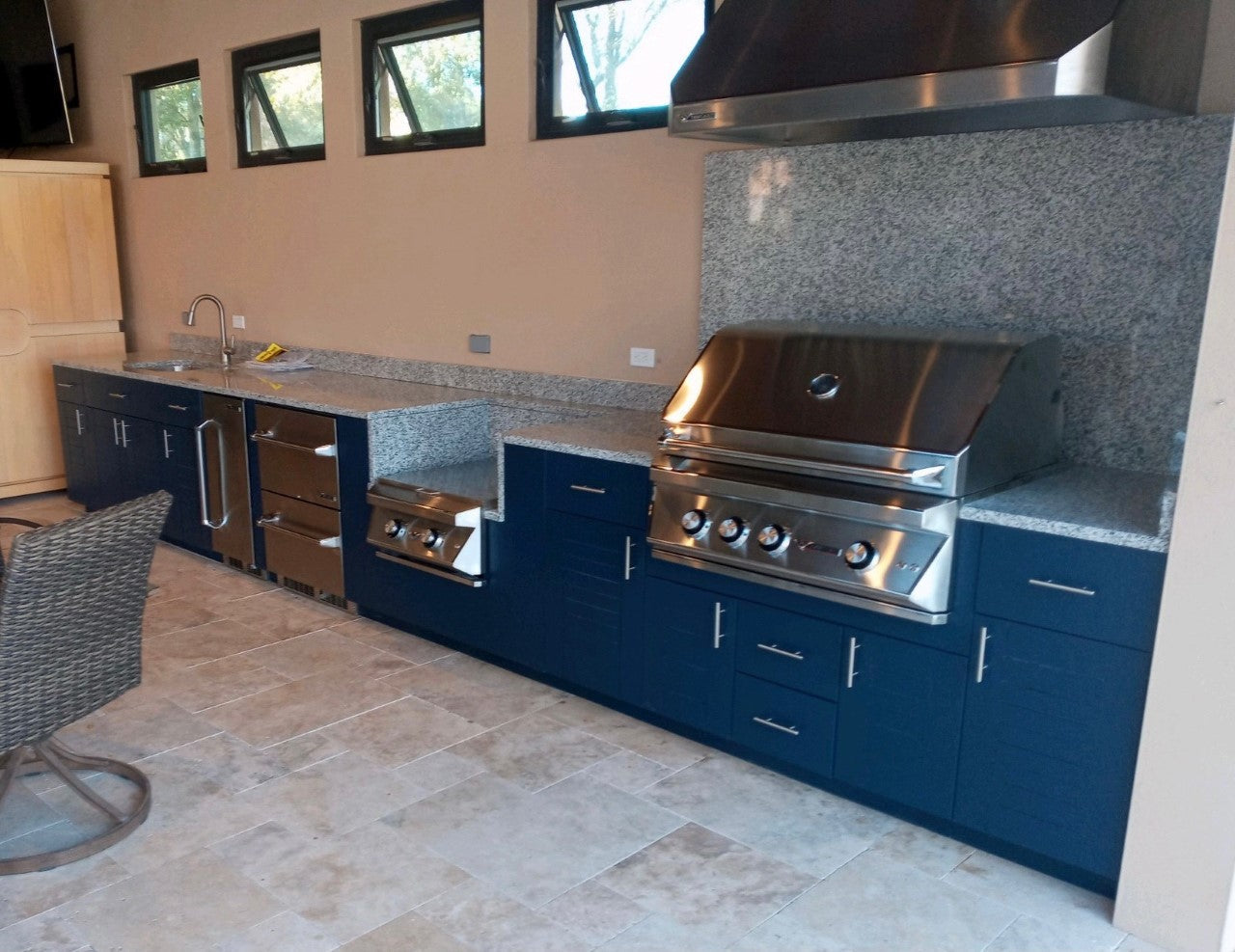
Key takeaways
An outdoor kitchen built from the right materials looks after itself almost entirely. The exceptions are worth knowing, because they are few and they are specific.
- Expect some water inside during heavy rain. That is normal, and there is a floor designed for it.
- Keep the vents clear. That one is safety, not housekeeping.
- Match the cleaner to the surface. Solid colour and woodgrain want different things.
- Keep hot cookware, tree sap and uncoated metal off the door faces.
- Lubricate the hinges and slides two or three times a year. This is the only job on the list that has consequences if you skip it.
What these cabinets can take, and where the limits are
Ours are welded aluminum frames with marine-grade HDPE doors and drawers and a 16 gauge 304 stainless countertop. Aluminum does not rust the way plain steel does, and polymer does not rot, warp or absorb moisture. That gives you a cabinet with very little to go wrong. It does not make it an indoor box that happens to live outside. Our weatherproof cabinet guide covers how these materials compare with the others sold for outdoor use.
No outdoor cabinet is watertight, and that is fine
Heavy rain or direct spray can put some water inside through door gaps. Every honest maker will tell you the same, and anyone who claims otherwise is overselling. What matters is where that water goes.
Every cabinet we build has an aluminum pan floor that closes out the bottom of each bay, so nothing sits on bare ground and water has somewhere to go instead of somewhere to sit. Aluminum and polymer do not absorb it, so minor intrusion does not damage the structure. The reason to wipe it out is the things you keep in there, not the cabinet.
What not to store inside
Paper goods, cardboard, matches, wooden tools, fabric and anything that clumps or spoils should live somewhere dry or in a sealed container. The cabinet resists moisture. Its contents may not.
And leave room around the vents. Do not pack the interior so tightly that air cannot move.
Rain and water
Keep the ventilation clear. This one is safety.
Vents are a designed feature, not trim. They must never be blocked, covered or obstructed, because restricted airflow around cooking and gas equipment creates a risk of heat buildup, fire or gas accumulation. Do not stack stored items against a vent, do not fit a cover that seals one, and do not line the appliance bay with foil, board or anything else. If a vent is damaged or obstructed, stop using the kitchen until it is cleared.
Checking takes two seconds every time you open a door. Make it part of putting things away.
Wipe out standing water after heavy rain
Open the doors, take an absorbent cloth to the pan floor and the rear corners, and look under anything stored on the floor. Drying it also gives you the chance to notice water arriving somewhere it should not, while it is still a small thing.
Placement, levelling and drainage
The cabinet should sit on a prepared surface with water able to move away from the base. Ours ship with adjustable leveling feet giving up to 1.5 inches of adjustment, which covers most patio slopes. Beyond that a slope may affect level installation and is worth advice before you order. After rain, look at whether water collects around the feet or against the cabinet, because good placement removes work from your routine permanently. If you are still planning the space, our guide to building an outdoor kitchen covers pad, drainage and appliance placement in order.
When it needs more than a cloth
Call someone if water keeps arriving during ordinary weather, a vent is damaged, the cabinet has shifted, or an appliance connection looks affected. Persistent damp usually points at placement or drainage rather than the storm.
Gas is separate and not a maintenance job. If you ever smell gas, turn off the supply valve, ventilate the area and call a qualified technician. Do not go looking for it while cooking.
Cleaning, surface by surface
Start with the gentlest thing that works and dry the surface afterwards. Different doors in the same kitchen want different treatment.
Solid colour doors: King StarBoard ST
For everyday dirt, a cleaner such as Soft Scrub with a nylon scrubby or a stiff nylon brush. Scrub lightly, because excess force can mar the finish. This is one of the most scratch-resistant outdoor polymers made, which is not the same as scratch-proof.
For grease or oil, a citrus cleaner, alcohol or mineral spirits. For a stain that will not shift, soaking the area with household bleach usually does it. Never use 100 percent pool chlorine, and never use a pressure washer on these faces. In severe cases a white nylon pad with a stronger solvent can be used with care, but coloured pads release dye and should not be.
Work in order rather than reaching for the strongest thing first:
- Mild soap and water for loose dirt.
- Citrus cleaner, alcohol or mineral spirits for grease.
- Bleach soak for a stubborn stain, tested somewhere out of sight first.
- Rinse and dry with a soft cloth.
Never use MEK, turpentine or naphtha on StarBoard ST. Keep teak oil, wood preservatives and wood stains away from it too, because they can permanently discolour the surface. Light sanding is a last resort on a small area only, since it removes the matte finish where you sand.
Woodgrain doors: SIMONA Polygrain
Mild dish soap and warm water with a soft cloth or sponge, following the direction of the embossed grain, then dried with a soft cloth. Hose off loose debris first if there is any. For tougher areas, half a cup of household detergent in a gallon of water.
A pressure washer at no more than 2000 psi can be used to take airborne dirt off, but never closer than about 8 inches, and not at close range on a door face at all. Avoid steel wool, abrasive pads and harsh solvent cleaners, which will scratch the embossed grain.
Both sheets are described in more detail in our HDPE cabinet guide, including why the colour running through the material is what makes most marks recoverable.
Powder coated countertops
Wipe with mild soap and warm water after each use and dry with a soft cloth to prevent water spots and mineral deposits. A light coat of car wax or a powder coat protectant once or twice a year helps maintain the finish.
We powder coat every top we build, grey or tan, at no extra cost, and we do not offer bare stainless. A coated top runs cooler in direct sun and does not show every mark. It can still get hot in full sun, so use some caution about what you set down on a surface that has been baking.
One thing not to do: the countertop is bedded on silicone rather than bolted down, and that bead both holds it and keeps the stainless from touching the aluminum frame. Do not try to lift, shim or reseat it. If the bead is ever cut or pulls away along an edge, call us before water gets into the joint.
The stainless you do have: your Blaze appliances
The grill face, the fridge door and the drawer fronts on the appliances are bare stainless, and that is the surface that wants the classic treatment. Once cooled, wipe with mild dish soap and a damp cloth, always in the direction of the grain rather than in circles. A stainless polish periodically protects and restores the shine.
Clean the grill grates with a brush while they are still warm, season them occasionally with a light coat of cooking oil, and for heavy buildup soak them in warm soapy water and use a non-metallic brush. Grease is far easier to remove soon after cooking than a week later.
Heat, sun and staining
Hot cookware does not go on the doors
Never rest hot pans, hot plates or a lit cigarette on a door or drawer face. Sustained heat above about 150 degrees will mark a polymer surface, and that mark is permanent. Use a trivet or a heat-safe surface and let cookware cool before it goes down.
Sap, berries and uncoated metal
Tree sap and berries can permanently discolour a lighter finish, so wash them off rather than letting them bake. Do not leave uncoated metal sitting on the surface either, because rust stains are very difficult to remove and worst on light colours. If the kitchen sits under or near planting, a quick look after windy weather catches most of it.
The appliance bay, and why there is no jacket in it
Our grills drop straight into a welded aluminum bay, and the polymer on the cabinet is out on the door faces where the weather is rather than wrapped around the appliance. So there is nothing combustible next to the fire and no insulated jacket or liner is needed.
Which leads to one care instruction people do not expect: do not add one. Do not line the bay with foil, board or any other material. Anything added inside that bay can block the ventilation the cabinet is designed around. Follow the clearances and installation instructions that came with your Blaze appliance, which always govern.
The hinges and the slides. The one part that needs you.
Almost everything above is about surfaces that look after themselves. The hinges and the drawer slides do not, and this is the part of the guide worth reading twice.
They are metal, they live outdoors, and they have moving faces, which is the combination that gets any hardware in the end. Left dry they will corrode, then stiffen, and eventually seize.
The whole job is a silicone-based spray lubricant on every hinge and drawer slide, two or three times a year, and more often if you are within a few miles of salt water. Work each door and drawer through its full travel afterwards so the lubricant spreads, and wipe away the excess so it does not collect dust. Put it on the calendar with the clock change and you will not have to think about it again.
Being straight with you: hardware that corrodes or seizes because it never got lubricated is wear from neglect, and no warranty covers that, ours included. The good news is that hinges and slides are screwed-in parts, so if one does eventually wear out we send you a replacement rather than you living with it.
While you are there, check that hinges and slide fasteners are still seated and tighten anything loose before a door starts to sag. Do not force a door or drawer that suddenly feels different; empty it, look at the track, and ask us if the part looks bent.
The frame, and what normal looks like
The frame inside your cabinet is bare aluminum and is meant to stay that way. Aluminum grows its own protective oxide skin and grows it back every time it is scratched, which no paint or powder coat can do. Light dulling or a chalky grey film on the frame or the pan floor over the years is normal, not a defect. Do not paint or coat it. There is more on why we build it that way on our how it's built page.
If something does get damaged
Here is the part that changes how you should think about a scratch. Every door, drawer face and end panel is screwed to the welded frame from the inside. Nothing is glued and no fastener shows on any face.
So a deep scratch across an end panel four years from now is not something you live with, and not a repair. It is a part. Call us with your order details, we ship the panel and the instructions, and the change takes about twenty minutes with a screwdriver.
Both sheet materials are coloured all the way through, so most marks clean or sand out as described above. But sanding removes the finish texture in that spot, so on a door or drawer face where it will show, ask us about a replacement panel before you sand a large area.
A routine that actually gets done
After cooking
Once things have cooled, wipe the countertop, the handles, the cabinet faces and the appliance exteriors. Brush the grates, empty the debris, and put accessories back somewhere that does not block a vent. If rain is coming, take out anything that will not like it.
Every few weeks
- Look for standing water, debris or a blocked vent.
- Check door alignment and drawer movement for anything that has changed.
- Look at the base and the patio for pooling or shifting.
- Look over appliance surfaces, hoses and visible gas connections.
The point is not to hunt for problems. It is to notice a small change while it is still small.
Before heavy weather, and before a long break
Clear the vents, take out anything moisture-sensitive, and check that water can drain away from the cabinet. Before a long period of nonuse, clean the appliances and remove anything perishable. If your kitchen has a water line, follow the appliance maker's winterising instructions rather than assuming the cabinet protects the plumbing.
Once a year
LP connections should be inspected annually by a qualified technician, and natural gas lines installed and inspected by a licensed plumber. Qualified installation is also a condition of the Blaze appliance warranty, so it is worth keeping the paperwork with the rest of your kitchen documents.
What is covered, plainly
We do not cover fading, because nothing anyone sells can honestly promise a colour will never shift in Florida sun. What we do not do is rule out corrosion altogether, which some of the biggest names in this category do in writing. The exception is hardware that never got maintained.
Blaze appliances carry their own warranty with one condition worth knowing early: register each appliance at blazegrills.com within 30 days of purchase and keep the receipt. Blaze covers main burners, cooking grids, body, flame tamers, warming racks and valves for life, and ignition and electronics for a year. It does not cover discolouration or surface rust.
Stop using the kitchen if a vent is damaged, a gas connection looks compromised, or an appliance behaves oddly. Photograph anything you want to raise with us, and keep your proof of purchase. Every kitchen ships with a full Care & Use Guide covering all of this in more detail.
Conclusion
Protecting an outdoor kitchen is mostly a matter of letting good materials do their job and handling the few things they cannot. Keep the vents clear, wipe out standing water, match the cleaner to the surface, keep heat off the door faces, and spray the hinges and slides two or three times a year. That is the whole list, and the last item is the only one that bites if you skip it.
Frequently asked questions
Are outdoor kitchen cabinets completely waterproof?
No, and no honest maker claims it. Heavy rain or direct spray can put some water in through door gaps. Ours have an aluminum pan floor so it has somewhere to go, and the fix is to wipe out standing water and keep moisture-sensitive things in sealed containers.
What should I do after heavy rain?
Open the doors, remove standing water from the pan floor and rear corners, dry the interior, and check the vents are clear. Then look at the patio around the base for pooling.
Can I use a pressure washer?
Not on solid colour StarBoard ST faces. On Polygrain woodgrain, up to 2000 psi is acceptable for airborne dirt but never closer than about 8 inches, and not at close range on a door. Mild soap, water and a nylon brush are safer for everything else.
How do I prevent sun damage?
Keep hot cookware off the door and drawer faces, since sustained heat above about 150 degrees marks polymer permanently. Wash sap and berries off promptly. Fading is the one thing no coating or colour can be promised against in Florida sun, which is why we do not claim it.
How often should the hardware be lubricated?
Two or three times a year with a silicone-based spray, more often near salt water. This is the one maintenance item with real consequences: hinges and slides left dry will corrode and eventually seize, and that is not covered by any warranty.
What happens if I scratch a door?
The colour runs all the way through both materials, so most marks clean or lightly sand out. For a deep scratch on a face that shows, call us: every panel is screwed on from inside, so we ship you a new one and the swap takes about twenty minutes with a screwdriver.
Does the grill bay need an insulated jacket or liner?
No, and please do not add one. The bay is welded aluminum with no polymer near the opening, so there is nothing combustible to shield, and anything added inside the bay can block the ventilation the cabinet is designed around.
When should I call a professional?
For persistent water intrusion during ordinary weather, damaged ventilation, a cabinet that has shifted, odd appliance behaviour, or anything gas-related. Gas work belongs with a licensed plumber or qualified technician, never with cabinet maintenance.
Keep reading
Build the one you have been reading about.
Layout, finish, appliances and a live price. Ships fully assembled, free in the lower 48.
Start your build →