HDPE Outdoor Kitchen Cabinets Guide
August 19, 2026
Key takeaways
An HDPE outdoor kitchen is not a plastic cabinet. It is a system: marine polymer where the weather is, welded aluminum where the load is, and stainless on top. What separates a good one from a bad one is how those three are joined.
- HDPE does not rot, rust or absorb water, and the colour runs through the sheet rather than sitting on it.
- Polymer moves. A lot. The cabinet has to be built to let it.
- Ask what carries the countertop. If the panels are the structure, the panels are doing two jobs at once.
- Ask whether the grill needs an insulated jacket. That answer is worth $600 to $1,000.
- Panels screwed on from inside are replaceable parts. Panels that are the structure are not.
What an HDPE outdoor kitchen is actually made of
High-density polyethylene is a dense, non-porous polymer used for boat consoles, dock hardware and commercial food surfaces. It does not absorb moisture the way wood-based material does and there is nothing in it for rot to feed on. It will scratch if you treat it roughly, so low maintenance is not the same as indestructible.
The useful part is that the colour and texture are the material, not a film on top of it. A scratch on a painted or lacquered face shows you the substrate. A scratch on solid polymer shows you the same colour it was before.
The two sheets we use, and why there are two
Solid colours are King StarBoard ST, a marine-grade polymer in twelve colours. Woodgrain is SIMONA Polygrain, an embossed HDPE in six: Onyx, Northeastern Walnut, Birch, Susquehanna Grey, Olyphant Oak and Teak. Both are coloured all the way through. Neither needs sealing, staining or refinishing, ever. Our weatherproof cabinet guide compares these against the other materials sold for outdoor use.
Look at samples outdoors before you choose. Sunlight changes how greys, tans and embossed grain read, and a finish that looks subtle on a screen can look much stronger on a patio in full sun.
The frame does the work the polymer should not
This is the part most comparisons skip. A 16 gauge stainless countertop, a grill, a full LP tank and whatever you set down while cooking is real weight sitting there for twenty years. In a welded frame that load runs down through the frame to the leveling feet, which is what a frame is for. In an all-polymer cabinet the panels are both the skin and the structure, so the same piece has to carry the countertop, take the weather and absorb its own movement at the same time.
Our frames are aluminum extrusion, cut to your build, squared in a jig and welded corner to corner into one rigid box. Not bracketed, not bolted. A weld cannot loosen, because once it cools there is no joint left to loosen. The frame ships bare aluminum, with bare pan floors, because a coating is the only thing protecting a coated frame and coatings fail first at cut edges and drilled holes. Bare aluminum grows its own oxide skin and grows it back when scratched. There is more on the metal itself in our aluminum cabinet guide.
Countertops
Ours are 16 gauge 304 stainless steel, powder coated grey or tan. Both are included and there is no upcharge for either. We do not offer bare stainless, because a coated top runs cooler in direct sun and does not show every mark. The bare stainless you will still have is on the Blaze appliances, and that is the surface that wants a conditioner now and then, wiped in the direction of the grain.
The top is bedded on silicone rather than bolted down, and that bead is doing two jobs. It holds the top to the frame and it keeps the stainless and the aluminum from ever touching, which is what stops two dissimilar metals corroding each other in salt air. Worth asking anyone what sits between their stainless top and their metal frame.
How much polymer moves, and why it matters
Everything grows and shrinks as it heats and cools. Polymer does far more of it than metal, and that single fact drives most of how an outdoor cabinet has to be built.
| Material | How much it moves | Across a 7 foot run | Softens or limits at |
|---|---|---|---|
| Concrete | 5.5 | 0.05 in | no practical limit |
| 304 stainless | 9.6 | 0.09 in | no practical limit |
| Aluminum | 13.1 | 0.13 in | no practical limit |
| PVC core | about 30 | 0.29 in | around 149°F |
| HDPE polymer | 61 to 72 | 0.63 in | 180°F |
Our doors are polymer too, so they move as much as anyone's. The question is never whether a material moves. It is whether the cabinet was built to let it.
The fastening method the sheet maker actually recommends
King Plastic's own guidance for this material is to fasten it mechanically and to drill the holes oversized so the panel can expand and contract freely. It also says plainly that gluing is not recommended, because very little bonds to polyethylene and nothing bonds to it for long.
So that is what we do. Every door, drawer face and end panel is screwed to the welded frame from the inside, through oversized holes. The fasteners sit hidden behind the door, the panel is free to move the way the material wants to, and no face of the cabinet has a screw head in it.
It is worth knowing what the alternative looks like. One maker machines a male and female joint along every panel edge and advertises it as a permanent, unbreakable bond. That is exactly what you do not want on the day you need one panel out.
Which is why a damaged panel is a part, not a repair
Put a deep scratch across an end panel four years from now and you do not have to live with it. We ship you the panel and the instructions and you are done in about twenty minutes with a screwdriver. Almost nobody else in this business can say that, and it is not because they did not think of it. When the panel is the structure, a damaged panel is a structural problem.
Heat, and the insulated jacket question
This is the part of an HDPE kitchen that deserves the most attention, and it is where the material's real limit sits.
Marine polymer has a maximum service temperature around 180 degrees and softens well before it melts. A grill runs several hundred. So put a grill inside a polymer box and the opening has to be lined with a metal jacket first. That is not our claim about anyone else's cabinets, it is the polymer industry's rule about its own material. One maker states plainly that a jacket is needed for safety if the kitchen is built from wood, PVC or HDPE. Another voids its warranty outright if a heat appliance goes in without one. A third requires a factory-made insulated liner.
A jacket runs $600 to $1,000 per grill. Ask before you compare cabinet prices, because it will not appear in the cabinet quote.
Our grills drop straight in. The frame around the appliance is welded aluminum, and the polymer on our cabinets is out on the door faces where the weather is, not wrapped around the appliance, so there is nothing combustible next to the fire to protect. We have been challenged on this, which is fair enough, and the answer is thousands of cabinets in the field and not one heat failure. Your appliance still arrives with its own installation instructions and those always govern.
One rule that applies to any cabinet: sustained heat above about 150 degrees will mark a polymer surface. Hot cookware and lit cigarettes do not belong on door or drawer faces, whoever built them.
Water, and what weatherproof honestly means
Weatherproof means resistant to the conditions it will meet, not watertight in a storm. Any outdoor cabinet can take some water in through door gaps during heavy rain, and a maker who tells you otherwise is overselling.
What matters is what happens to the water that does get in. Every one of our cabinets has an aluminum pan floor that closes out the bottom of each bay, so nothing sits on bare ground and rain has somewhere to go instead of somewhere to sit. Aluminum and polymer do not rot, warp or absorb moisture, so incidental water does not damage the structure. Do not store moisture-sensitive things inside, and wipe out standing water after heavy rain as a routine.
Ventilation is the other half of this. Vents are a safety feature, not trim. They must never be blocked, covered or lined, and that includes not adding an insulating box inside the appliance bay.
Planning the layout
Good planning starts with movement through the space, not with cabinet count.
Measure the pad and the route
Measure the usable pad rather than the whole patio. Record walls, posts, steps, roof supports, gates and the route from where the truck can stop to where the cabinet has to sit, including the narrowest point and the turning radius. Then check vertical clearances under roofs and pergolas. A few extra inches of circulation makes more difference than using every available inch.
Choose the layout
A straight run suits a wall and keeps everything in reach. An L divides cooking from serving and gives guests a corner out of the cook's path. We build straight runs at 5, 6 and 7 feet and one L at 7 by 4. We do not build U-shapes, islands or freestanding modular pieces. Our configurator prices any of those combinations live as you choose them.
Place the appliances first, then fill in around them
Appliances set the rhythm of the kitchen, and their openings are not interchangeable between brands.
- Place the grill first and identify its working zone.
- Put a side burner next to the prep surface, not across the run from it.
- Keep refrigeration away from the hottest section.
- Reserve one uninterrupted stretch of counter for plating.
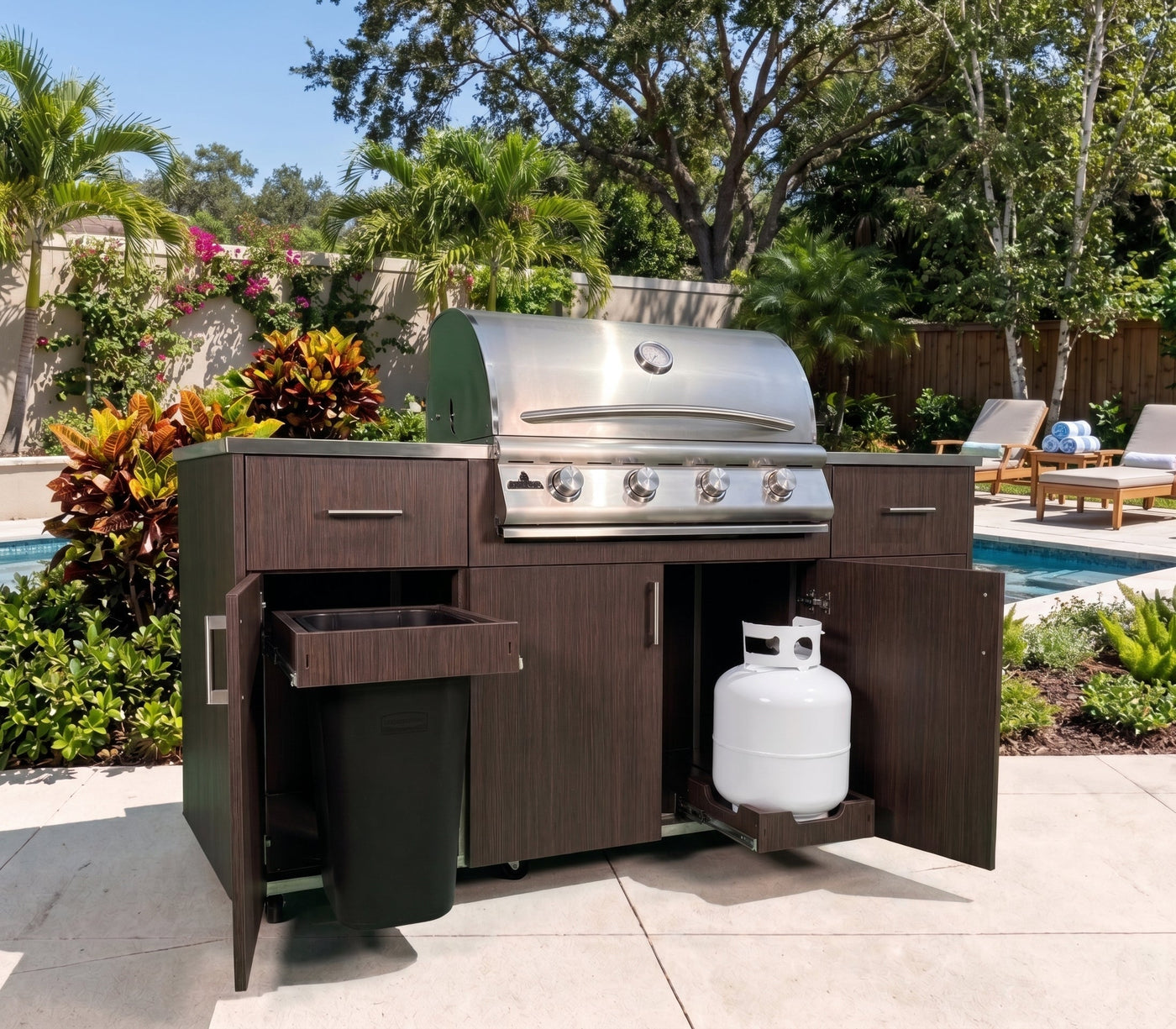
We fit Blaze only. The 20 inch refrigerator is a BLZ-SSRF20-4.3 at 4.3 cubic feet, and every cutout is made for the appliance you chose before the frame leaves the jig. A trash slide-out and an LP tank slide-out are standard in every kitchen we build.
Delivery and installation
Delivery is part of the design of a finished cabinet, not an afterthought.
Assembled means different things
Ready-to-assemble cabinets arrive as panels, hardware and instructions, and you square and fasten the boxes before appliances and countertops go near them. Ask exactly what "assembled" includes, because it is not a standard term.
Ours ship fully assembled with the countertop already installed. Straight runs arrive as one piece. The L arrives in two sections that bolt together on site. Set it, level it, connect the gas, cook the same day. Most setups run under an hour, and freight is free in the lower 48.
Levelling
Every cabinet ships with adjustable leveling feet giving up to 1.5 inches of adjustment, which covers most patio slopes. Beyond that a slope may affect level installation, so measure the pad rather than assuming the feet will correct it. The feet fine-tune the position; the pad still carries the load.
Gas
Treat this as safety-critical rather than the last cosmetic step. Natural gas should be connected by a licensed plumber, and a qualified installer is required for any gas appliance for the Blaze warranty to be in effect. The LP regulator connects to the grill on site: tighten it with a wrench and leak test every joint with soapy water before lighting. If you ever smell gas, shut the supply off, ventilate, and call a professional.
How to look after it
Outdoor materials reduce maintenance. They do not remove it.
Solid colour doors, King StarBoard ST
For everyday dirt, a cleaner such as Soft Scrub with a nylon scrubby or a stiff nylon brush. Scrub lightly, because too much force can mar the finish. Stubborn stains usually come out by soaking the area with household bleach, and grease responds to a citrus cleaner, alcohol or mineral spirits. Never use pool chlorine and never use a pressure washer on these faces.
What to avoid: MEK, turpentine and naphtha. Teak oil, wood preservatives and stains, which can permanently discolour the surface. Uncoated metal left sitting on it, because rust stains are very hard to get out of lighter colours. Tree sap and berries, so wash frequently if the kitchen sits under planting.
Woodgrain doors, SIMONA Polygrain
Soap and fresh water with a soft cloth, wiping along the grain. Hose off loose debris first if there is any. For tougher areas, half a cup of household detergent in a gallon of water. A pressure washer at no more than 2000 psi can be used for airborne dirt, but never closer than about 8 inches, and never at close range on a door face. Avoid abrasive pads and steel wool, which will scratch the embossed grain.
The one part that needs you
Everything above is about surfaces that look after themselves. The hinges and the drawer slides do not. They are metal, they live outdoors and they have moving faces, which is the combination that gets any hardware in the end. Left dry they will corrode, then stiffen, then seize.
A silicone spray on every hinge and slide two or three times a year is the whole job, more often near salt water. Work each door and drawer through its full travel afterwards. Hardware that seizes from lack of lubrication is wear from neglect and no warranty covers it, ours included. They are screwed-in parts, so if one does wear out we send you a replacement.
Quality, warranty and what it is worth
What to check
Ask what forms the frame and how the joints are made. Ask what the door colour is made of. Ask what carries the countertop. Ask how the panels are attached. Those four answers describe an outdoor cabinet far better than the phrase "outdoor rated" does. Then look at gaps, door alignment, drawer movement and countertop fit, because those show whether the maker treats the cabinet as one system.
Read the warranty document, not the warranty page
Cabinet and appliance warranties are separate documents with separate terms. Check duration, who is covered, whether it transfers, and whether labour and freight are excluded. Then read the exclusions, because that is where the real position sits.
Ours in plain terms: we do not cover fading, because nothing anyone sells can honestly promise a colour will never shift in Florida sun. What we do not do is rule out corrosion altogether, which some of the biggest names in this category do in writing. The exception is hardware that never got maintained.
Blaze appliances carry their own warranty and one condition worth knowing before delivery day: register each appliance at blazegrills.com within 30 days of purchase and keep the receipt. Blaze covers main burners, cooking grids, body, flame tamers, warming racks and valves for life, and ignition and electronics for a year. It does not cover discolouration or surface rust.
Compare the whole project, not the cabinet price
Include freight, the countertop, appliances, gas connection, pad preparation, any labour, and an insulated jacket if the cabinet needs one. Our straight runs start at $6,774 and the L at $8,474, complete with the countertop and free freight in the lower 48. Our cost guide breaks down where the money goes on a project of this kind, and the how it's built page shows the frame the rest of it hangs on.
Conclusion
An HDPE outdoor kitchen works when each material does the one job it is good at: polymer out on the faces taking the weather, aluminum inside carrying the load, stainless on top for the work surface, and every panel attached in a way that lets the polymer move. Ask how the frame is joined, ask what happens to a scratched panel, and ask whether the grill needs a jacket. The answers will separate the cabinets quickly.
Frequently asked questions
Are HDPE outdoor kitchen cabinets waterproof?
They resist outdoor moisture, but no outdoor cabinet is watertight. Heavy rain can put some water in through door gaps, which is why ours have an aluminum pan floor to give it somewhere to go. Do not store moisture-sensitive items inside and wipe out standing water after a storm.
Do HDPE cabinets rot or warp?
HDPE does not rot and does not absorb moisture, so it will not warp the way wood-based material does. It does expand and contract with temperature, considerably more than metal, which is why the panels have to be fastened in a way that lets them move.
Does an HDPE cabinet need an insulated jacket for the grill?
If the polymer is what surrounds the appliance opening, usually yes, and most makers in that position require one. Budget $600 to $1,000 per grill. On a welded aluminum frame with the polymer out on the door faces, there is nothing combustible next to the appliance and no jacket is needed.
Are welded aluminum frames better than bolted ones?
A welded frame is one continuous structure. A bolted frame has a fastener in every structural joint, and fasteners are the part that answers to twenty years of daily heat cycling and a few days on a freight truck. Ask to see a photograph of the bare frame.
What countertop works with HDPE cabinets?
16 gauge 304 stainless is the practical choice: durable, cleanable and suited to cooking. We powder coat every top in grey or tan at no extra cost and do not offer bare stainless, because a coated top runs cooler in the sun and shows fewer marks.
Can HDPE cabinets go on a sloped patio?
Modest slopes are handled by the adjustable leveling feet, up to 1.5 inches on ours. A larger slope needs the pad addressed before delivery rather than corrected at the feet.
Do outdoor kitchen gas connections need a professional?
Yes. Natural gas should be connected by a licensed plumber and LP by a qualified technician, and qualified installation is a condition of the Blaze appliance warranty. Local codes and the appliance instructions always take priority.
Keep reading
Build the one you have been reading about.
Layout, finish, appliances and a live price. Ships fully assembled, free in the lower 48.
Start your build →