Aluminum Outdoor Kitchen Cabinets Guide
August 19, 2026
Key takeaways
- A welded aluminum frame gives you a rigid cabinet box with nothing that can rust or work loose.
- Marine-grade polymer doors will not rot, warp or absorb water, and the color runs all the way through.
- Our straight runs start at $6,774 and L-shapes at $8,474, with freight included in the lower 48.
- Layout, cabinet size, appliance clearance, ventilation and gas access all have to be planned together.
- Compare the finished project, not the cabinet price. Site work and gas labor are real numbers.
What aluminum outdoor kitchen cabinets are
An aluminum outdoor kitchen is a welded frame, weatherproof doors and a stainless top, built as one run and set on your patio ready to cook on. Unlike indoor cabinetry it has to handle rain, humidity, sun, temperature swings, grease and the occasional puddle. The word aluminum on its own tells you very little. Frame design, door material, countertop grade, hardware and ventilation are what decide whether it lasts.
How a welded frame is built
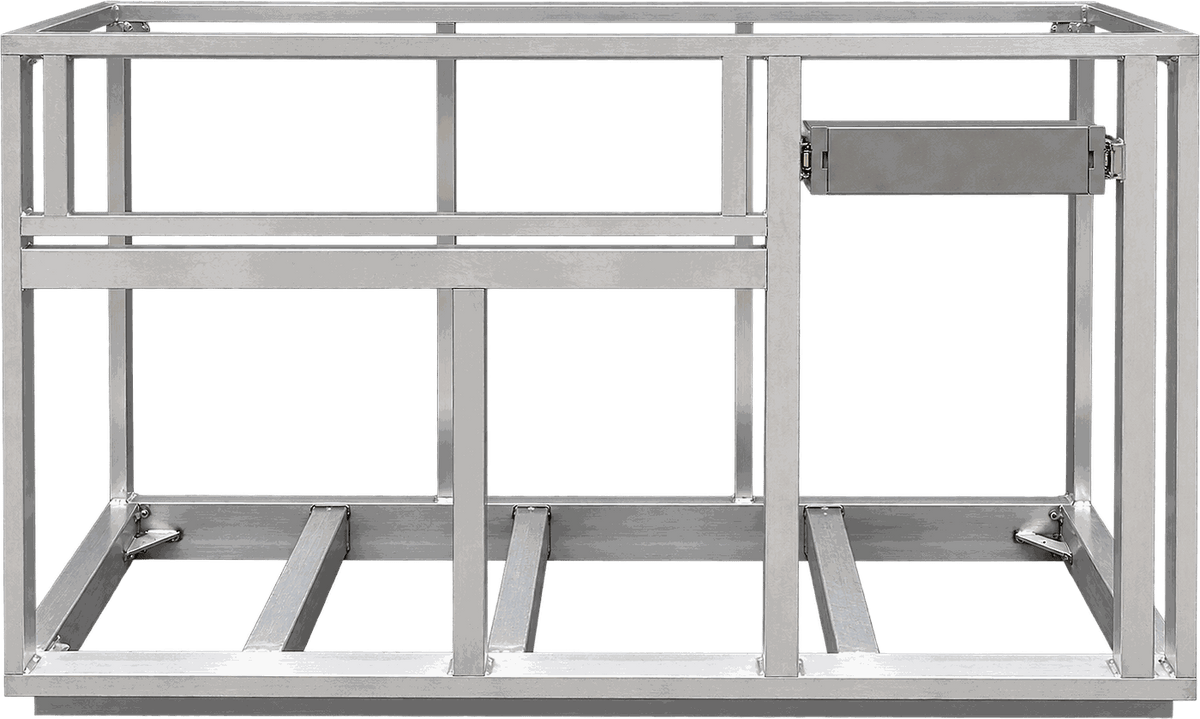
A welded frame starts as aluminum extrusions cut and squared into a cabinet body. The joints are welded rather than held together with fasteners, which makes one continuous structure that can carry a countertop and built-in appliances without flexing. Good fabrication depends on accurate jigs, consistent welds and careful finishing, because a frame that is slightly out of square makes every door and drawer harder to align.
We weld every frame on a jig in our shop in Homosassa, Florida. That is the reason our boxes come out square and stay square after a week on a truck. When you are comparing manufacturers, ask where the welding happens and who owns the building. That answer tells you more than the word "premium" ever will.

Why marine-grade polymer doors work outdoors
Marine-grade polymer, made from HDPE or a related solid sheet, does not absorb moisture the way unfinished wood does. It will not rust, rot or warp, and a well-chosen outdoor polymer keeps its shape through years of wet and dry cycles.
We use two sheets. King StarBoard ST for the solid colors, twelve of them, and SIMONA Polygrain for the six embossed woodgrains: Birch, Olyphant Oak, Teak, Susquehanna Grey, Northeastern Walnut and Onyx. Both are colored all the way through, so a scratch does not expose a different material underneath, and neither one is a laminate that can peel at the edge.
Weather resistant is not indestructible. Scratches, grease, tree sap, berries and concentrated heat can all mark a polymer surface, so routine cleaning and keeping hot cookware off the doors still matter. A soft cloth, mild soap and water is the right starting point for both materials.
The role of the 304 stainless countertop
The countertop takes more daily contact than anything else in the kitchen: food prep, serving, spilled sauces, hot pans. 304 stainless is the standard choice because it is durable, cleanable and made for food-service environments. A 16-gauge top gives you a substantial surface that does not oil-can under weight.
We powder coat every top we build, grey or tan, at no extra cost, and we do not offer bare stainless. A coated top runs cooler in Florida sun, it does not throw glare back at you in the evening, and it does not show every fingerprint from a busy Saturday. Stainless picks up small marks with use, particularly if you wipe across the grain or drag grit across it. That is cosmetic, not structural.
How aluminum compares with wood, steel and masonry
The useful comparison is not which material is strongest. It is how each one behaves after years of moisture, sunlight, maintenance and the occasional repair.
| Material | Main advantage | Common outdoor concern |
|---|---|---|
| Welded aluminum | Light, rigid, will not rust | Hardware and finish still need care |
| Marine-grade polymer | Resists rot, moisture and warping | Can scratch or mark under concentrated heat |
| 304 stainless | Durable, hygienic work surface | Shows scratches and water spots if left bare |
| Masonry | Permanent, substantial appearance | Heavy construction, hard to change later |
| Wood | Warm appearance | Continuous sealing, inspection and refinishing |
Aluminum cabinetry sits in the middle: more permanent than a cart, less fixed than a masonry island, and considerably less site work than either. You can see how we put ours together on the how it's built page.
Designing the layout
Start with how you cook, not with cabinet shapes. Think about where food is stored, where it gets prepared, where the grill sits, and how people move between the kitchen, the table, the house and the pool. Leave room for open doors and drawers without creating a pinch point.
A sketch with real measurements beats a polished rendering at this stage. Mark walls, railings, steps, posts, roof edges, utility lines, and the route a freight truck will need.
Straight run or L-shape: how to pick
We build two shapes. A straight run in 5, 6 or 7 feet, and an L-shape at 7 by 4. The straight run suits a wall or a patio edge and is what most people order. The L adds a second work surface and separates cooking from serving, which is worth the extra footprint if more than one person cooks. Check both against your delivery route, not just your patio.
Cabinet size and countertop depth
Measure the usable depth and the finished height, not only the width. Appliance doors, grill lids, refrigerator handles and drawer pulls all reach into the space you walk through, so the footprint alone does not tell you how much room the kitchen occupies. Allow clearance for opening and servicing appliances, not just for fitting them.
Finishes, doors and accessories
Choose finishes after you decide how much attention the kitchen should draw. Woodgrain fronts echo decking and outdoor furniture. Solid colors make a longer run feel quieter. Trash and LP tank slide-outs come standard in every kitchen we build, so the two least glamorous storage problems are already solved before you start adding anything.
A workable order for the decisions:
- Place the grill and any other heat-producing appliance.
- Add the refrigerator and the food prep zone.
- Reserve landing space beside both hot and cold appliances.
- Fill what is left with drawers, doors and utility storage.
- Review sightlines, traffic and service access before you order.
Patio slope and leveling feet
Outdoor patios are rarely flat, particularly where drainage was designed in. Our adjustable feet give up to 1½ inches of travel, which handles most slopes. Measure the difference from one end of the proposed run to the other rather than assuming the patio is level because it looks level. If the slope exceeds the adjustment range, the base needs work before delivery. Loose shims are not a substitute and they move under load.
Appliances
Appliances should serve a real cooking pattern. A grill is the obvious start, but a side burner, a refrigerator or a bigger prep surface may matter more depending on how you entertain. Each addition uses counter space, storage, power, ventilation or gas capacity, so build the appliance list alongside the layout rather than after it.
Built-in grills and side burners
A built-in grill needs a correctly sized opening, solid support and proper clearance around the heat. Leave landing space on at least one side and think about where the lid travels when it is open. A side burner earns its spot if you make sauces, boil water or want a second cooking zone outside, but it should not eat the prep surface next to the grill.
We fit Blaze appliances, grills and side burners, and nothing else. We picked one brand and learned it properly rather than carrying six. Whichever appliance you choose, verify the model dimensions, gas type, required clearances and ventilation instructions rather than going off the product category.
Outdoor refrigeration and prep zones
The Blaze 20-inch outdoor refrigerator holds 4.3 cubic feet, is UV rated and weatherproof, and sits flush in the cabinet opening. Position it near the prep counter but away from the hottest part of the grill enclosure, and give it the airflow and the circuit it needs. Prep space belongs between storage and cooking wherever the run allows it.
Ventilation and gas
Ventilation is a safety requirement, not a decorative detail. Never cover cabinet vents, place stored items against them, or seal an enclosure in a way that stops airflow. Natural gas connections should be completed by a licensed plumber, and LP systems installed or inspected by a qualified technician. If you smell gas, shut off the supply if it is safe to do so, leave the area, and call the appropriate professional.
Ordering, delivery and installation
Configuring the kitchen and seeing the price live
Our configurator lets you pick layout, size, door finish, countertop, appliances and accessories and watch the price move as you go. Nothing is hidden until checkout. Build it, then call us about anything unusual on your site or your utilities before you order.
Fully assembled, not a kit
Ready-to-assemble kits arrive as panels, hardware and instructions. They are easier to carry through a narrow gate, but they hand assembly, alignment and countertop work to you or your contractor.
Our cabinets ship fully assembled with the countertop installed. A straight run arrives as one welded piece. An L-shape ships in two sections that bolt together on arrival. Once the pad and the gas connection are ready, the remaining work is placement, leveling, joining the two sections if you have an L, and setting the appliances.

Freight, access and placement
A freight delivery is not a parcel delivery. The carrier needs a practical drop-off point, and you need a plan for getting the unit from there to the patio. Check gate widths, pathway turns, steps, slopes and available help before delivery day. A unit that fits the patio may not fit the route to it. Protect paving and decking while you move it, have the leveling tools ready, and inspect for damage before you position anything permanently.
What it costs
The cost of an outdoor kitchen is shaped by more than the cabinet. Length, countertop finish, appliance count, drawers, accessories, delivery conditions, site preparation and professional utility work all move the final number. Budget in layers: cabinetry, appliances, delivery, foundation or patio work, electrical, and gas installation.
Our pricing
Our straight runs start at $6,774 and L-shapes at $8,474. That includes the welded frame, the doors and drawers you pick, a 16-gauge 304 stainless countertop powder coated grey or tan, the trash and LP tank slide-outs, and freight to anywhere in the lower 48. Appliances are priced on top of that.
Prices move, so the configurator is the place to see a real total for a real build rather than working from a starting figure. Our cost guide breaks down what else belongs in an outdoor kitchen budget.

Real cabinet from our shop, color and setting enhanced with AI.
What moves the number up or down
Scope is where the big differences live. More counter length, more appliance openings, extra drawers, difficult access and site work all add cost. A shorter run, fewer appliances, a prepared pad and a standard finish keep the project focused.
Before you cut a feature to save money, ask whether it affects daily use. Dropping a rarely used accessory is sensible. Dropping the landing space beside the grill makes the kitchen annoying every time you cook.
DIY versus a contractor
If the cabinets arrive assembled and the patio is already sound, most of the work is moving, leveling and fitting appliances. You will still want help with the freight and, if you have an L, with joining the two sections. Natural gas work goes to a licensed plumber, and any electrical or structural work follows local requirements. A contractor makes more sense when the site needs grading, a new slab, utility extensions or drainage changes.
Shipping and warranty
Shipping is included across the contiguous United States. Our cabinet warranty is a limited lifetime residential warranty covering defects in materials or workmanship under normal use, for the original purchaser, and it excludes labor and shipping. Appliances, countertops, hardware and leveling parts may carry separate manufacturer coverage. Blaze warranties the major components of their grills for life, under their own terms.
Maintenance
Wipe grease off after cooking and the rest mostly takes care of itself. For woodgrain Polygrain doors use mild dish soap, warm water and a soft cloth, wiping along the grain, then dry. Solid StarBoard ST tolerates a nylon scrubber for everyday dirt with light pressure, and a citrus cleaner, alcohol or mineral spirits for grease. Never use MEK, turpentine or naphtha on StarBoard ST, and skip steel wool, abrasive pads and close-range pressure washing on both materials.
Your powder-coated countertop wants soap, water and a dry-off, plus a light coat of car wax or a powder-coat protectant once or twice a year. The bare stainless on your Blaze appliances is what wants a stainless conditioner periodically, wiped with the grain.
Inspect hinges, slides, handles, leveling feet and vents a few times a year, tighten anything loose, and use a silicone-based lubricant on the moving hardware two or three times a year. LP connections should be inspected annually by a qualified technician. If the cabinet shifts, doors stop aligning, or you smell gas, stop and sort it out before cooking again.
Conclusion
Aluminum outdoor kitchen cabinets work when the frame, the doors, the countertop, the layout, the appliances and the installation are planned as one thing. Compare the whole project rather than a single price, get the delivery route and the pad ready in advance, and keep the maintenance simple from day one.
Start in the configurator, or see what other people have built in the gallery.
Frequently asked questions
What do Fire Islands outdoor kitchens cost?
Straight runs start at $6,774 and L-shapes at $8,474, including the cabinet, doors, a powder-coated 16-gauge 304 stainless countertop, the trash and LP tank slide-outs, and freight in the lower 48. Appliances are extra. The configurator shows a live total.
Are aluminum cabinets suitable for rainy climates?
Yes. Aluminum framing and polymer panels are well suited to rain and humidity, but no outdoor cabinet is completely watertight. Good drainage, clear ventilation and wiping out standing water still matter.
Do aluminum cabinets rust?
Aluminum does not rust the way ordinary steel does. Other components, including hardware and appliance parts, use different metals, so the whole cabinet still gets cleaned and inspected periodically.
What layouts do you offer?
A straight run in 5, 6 or 7 feet, and an L-shape at 7 by 4. We do not build U-shapes or freestanding modular pieces.
Aluminum or masonry?
Neither is universally better. Aluminum is lighter, arrives finished and needs far less site construction. Masonry is permanent and heavy and involves real building work. The right answer depends on your site, budget and how much future flexibility you want.
Can I connect the gas myself?
Natural gas work should be completed by a licensed plumber and must follow local code. LP installations need correct components and leak checks, so use a qualified professional whenever the setup is uncertain.
How often should the cabinets be cleaned?
Wipe surfaces after cooking and clean more thoroughly as grease, pollen or stains appear. Inspect hardware, vents, leveling feet and gas connections periodically, with LP connections checked annually by a qualified technician.
Keep reading
Build the one you have been reading about.
Layout, finish, appliances and a live price. Ships fully assembled, free in the lower 48.
Start your build →