Custom Outdoor Kitchen Cabinets Explained
August 19, 2026
Key takeaways
- "Custom" means different things at different companies. Ask what is actually being customized before you compare quotes.
- We build cabinets: two layouts, a fixed set of sizes, configured and priced online.
- If your project needs more than cabinets, we put you on a call and hand you to a preferred dealer in your area.
- Every kitchen ships fully assembled with the countertop installed and freight included in the lower 48.
- Where a company stops is more useful information than what it promises.
What people mean by "custom"
Custom is one of the least useful words in this industry. At one company it means you picked the door color. At another it means a designer draws your patio and a crew builds a masonry island in it over three weeks. Those are wildly different products at wildly different prices, and both get called custom in the same search results.
So it is worth being blunt about what we do, because it will save you a phone call either way.
What we build
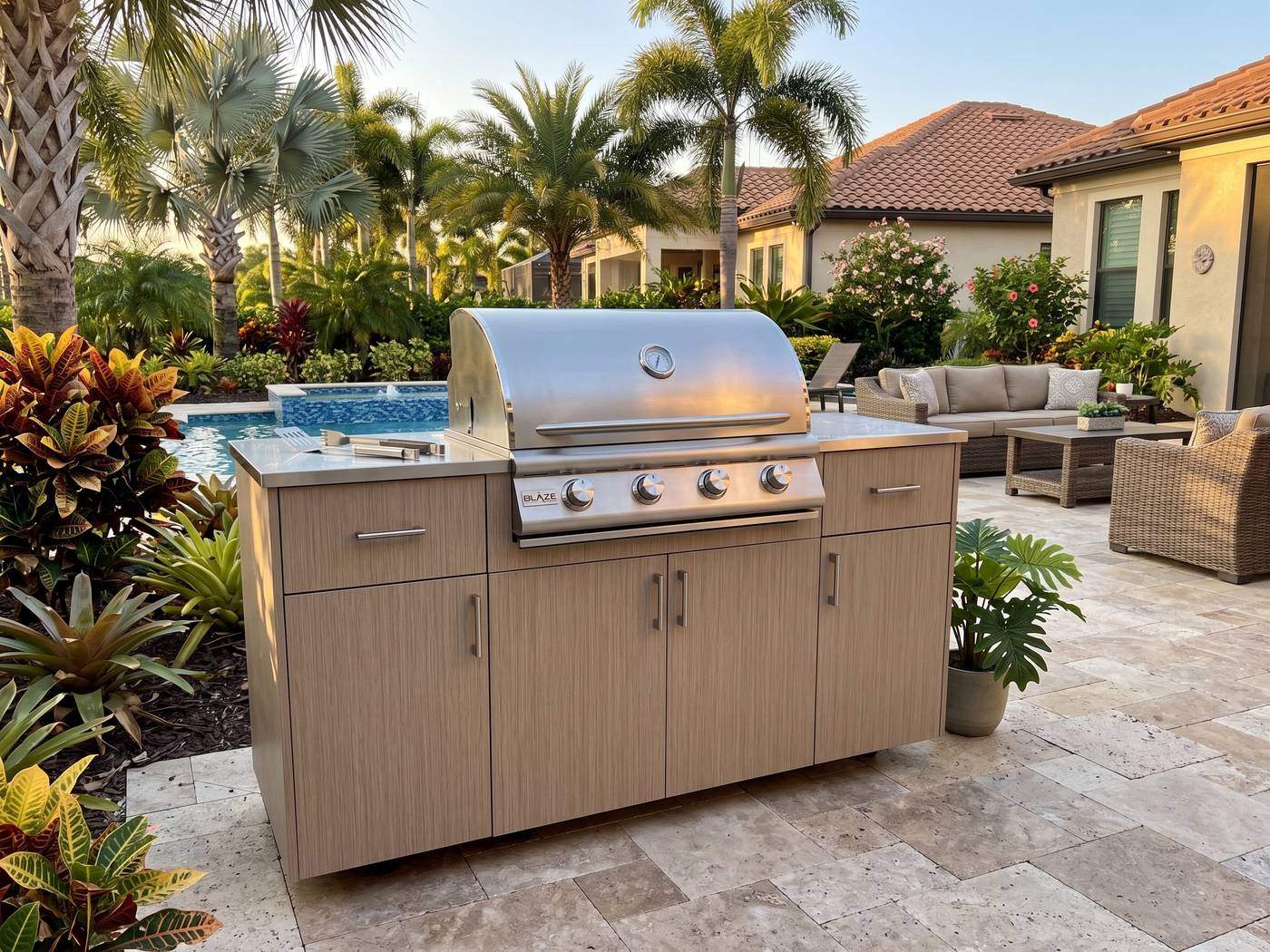
We build outdoor kitchen cabinets. Welded aluminum frames, marine-grade polymer doors, a 16-gauge 304 stainless countertop powder coated grey or tan, and Blaze appliances fitted into openings we cut to the appliance. Two layouts: a straight run in 5, 6 or 7 feet, and an L-shape at 7 by 4. You configure it online, you see the price move as you go, and it arrives at your house fully assembled.
That is the whole product. It is deliberately narrow. We would rather build two shapes properly in our own shop than offer twelve and subcontract half of them.
What we do not build
We do not supply countertops beyond the stainless top that comes on the run. We do not supply appliances beyond Blaze. We do not do stone, plumbing, electrical, pergolas or installation. We do not build U-shapes, islands or freestanding modular pieces.
None of that is a limitation we are embarrassed about. It is the reason the part we do build is good.
Start with your space and how you cook
A good outdoor kitchen starts with the place it will occupy, not with a catalog. Before you compare finishes, walk the patio and think about how your household actually cooks.
Measure the patio, deck or outdoor living area
Measure the usable surface, not the whole yard. Record wall lengths, posts, steps, doors, gates, roof supports and the swing of any nearby door. Note where the gas, electrical and water connections are. Then measure the route a delivered cabinet has to travel from the street to its final position, including the narrowest gate and any overhead branches.
Take photos from several angles and mark the fixed obstacles on a simple sketch. Rough measurements are fine for a first conversation. Verify them before you order.
Choose between a straight run and an L-shape
A straight run is the simplest thing to place along a wall or a patio edge, and it is what most people want. An L gives you a corner, which is worth having if two people cook, if you want prep space that is not also landing space, or if you want the grill turned away from where everyone stands.
Sketch the steps from refrigerator to prep surface to grill, then imagine three guests standing nearby. Leave enough room to open an appliance door without blocking the main walking route.
Plan cooking, prep, serving and storage zones
Think in zones: cold storage, prep, cooking, plating, cleanup. They do not have to be elaborate, but they should follow a sensible order so raw ingredients, hot food and serving surfaces are not competing for the same small patch of counter.
Trash and LP tank slide-outs come standard in every kitchen we build, so the two least glamorous storage problems are already solved.
Clearance, ventilation and safe appliance placement
Every grill, burner, refrigerator and gas compartment needs the clearance and ventilation specified for that appliance. Never cover a vent or pack the cabinet so tightly that airflow is obstructed. Heat buildup and accumulated gas are safety risks, so local code and manufacturer instructions guide the installation, not a layout drawing.
Materials built for permanent outdoor use
Welded aluminum frames
A welded frame forms a continuous structural box rather than a collection of panels held together by fasteners. We weld every frame on a jig in our shop in Homosassa, Florida, which is how the box comes out square and stays square. It will not rust, rot or warp, and there is nothing in it that can work loose over ten summers.
Aluminum still needs a stable, reasonably level base, sensible drainage and clear ventilation. Material choice lowers certain risks. It does not replace good planning. There is more detail on the how it's built page.

Marine-grade HDPE and polymer doors
HDPE is used in marine settings because it handles moisture without behaving like untreated wood. We use two sheets: King StarBoard ST for twelve solid colors, and SIMONA Polygrain for six embossed woodgrains: Birch, Olyphant Oak, Teak, Susquehanna Grey, Northeastern Walnut and Onyx.
Both are colored all the way through, so a scratch does not expose a different material, and neither is a laminate that can peel at an edge. Compare samples outdoors if you can. A finish that looks right under a showroom light reads differently beside your paving and your siding at four in the afternoon.
The countertop
Every top we build is 16-gauge 304 stainless, powder coated grey or tan at no extra cost. We do not offer bare stainless. A coated top runs cooler in direct sun, it does not glare, and it does not show every fingerprint. Grey reads cooler and more modern. Tan warms the run up beside brick and travertine.
Appliances and accessories
Choose appliances before finalizing cabinet openings. Built-in grills, side burners and outdoor refrigerators have specific dimensions, ventilation requirements and connection points, and a cabinet that is merely close in size is not close enough.
We fit Blaze appliances: grills, side burners and outdoor refrigeration. One brand, learned properly. The 20-inch refrigerator holds 4.3 cubic feet, is UV rated and weatherproof, and sits flush in the opening. Blaze warranties the major components of their grills for life under their own terms, which is separate from our cabinet warranty and worth reading on its own.
Storage that follows how you cook
A compact mix is usually more useful than a row of identical doors. A drawer for utensils, a larger compartment for pans, and a dedicated place for waste. The best arrangement keeps the countertop clear while preserving safe airflow, rather than filling every available inch.
Assembly, delivery and installation
Fully assembled versus ready-to-assemble
Ready-to-assemble cabinets arrive as separate panels and hardware, and you or your installer square, fasten and finish the unit. Fully assembled cabinetry arrives complete, which removes the on-site construction and most of the opportunities for something to end up out of alignment.
We ship our cabinets completely built with the countertop installed. A straight run arrives as one welded piece and an L-shape in two sections that bolt together on your patio. Freight is included across the contiguous United States.
Preparing the delivery path and installation surface
The pad should be sound, clear of debris and accessible from where the truck can stop. Measure the narrowest point on the route, including gates and turns, and check for overhead obstructions. Larger units may need an extra person or moving equipment.
Once the cabinet is in place, inspect the countertop, doors, drawers and frame before completing setup, and photograph any shipping damage before you sign.
Leveling on an uneven patio
Our leveling feet give you up to 1½ inches of adjustment, which covers most patio slopes. Past that the pad wants correcting first, and loose shims are not a substitute because they move under load. After leveling, open every door and drawer to confirm the cabinet operates smoothly.
Gas
Outdoor kitchen gas work is a safety-critical installation, not a final cosmetic step. Natural gas connections should be completed by a licensed plumber, and LP connections installed or checked by a qualified technician. Our kitchens and fire tables run on natural gas or liquid propane, but the connection varies by site. Do not use the kitchen until the line has been properly connected and tested.
What happens when you need more than cabinets
We build cabinets. Configured, welded and finished in our own shop, in two layouts and a fixed set of sizes. We do not supply countertops beyond the stainless top that comes on the run, we do not supply appliances beyond Blaze, and we do not install.
If your project needs more than that, call us. We will work out on the phone what you actually need, and then hand you to one of our preferred dealers in your area. They design it, quote it, build it and install it. We build the cabinets and warranty them. The dealers are independent businesses and they stand behind their own work.
You can read how that works, and see the areas we currently cover, on the custom page. If you would rather just talk it through, book a call.

Real cabinet from our shop, color and setting enhanced with AI.
What to ask any provider before you sign
Whoever you buy from, insist on a line-by-line quote. It should identify the cabinet configuration and finish, countertop material and cutouts, appliance models, delivery terms, and any assumptions about connections. If a sink, lighting, ice maker or accessory is not included, it should be clearly marked as an exclusion.
Written inclusions are what keep a friendly design conversation from turning into an ambiguous construction agreement. A total can only be compared fairly when the scope is comparable, and one quote including a countertop and delivery is not the same as another that leaves both out.
Durability, warranty and maintenance
What the cabinet warranty covers
We back our cabinets with a limited lifetime residential warranty against defects in materials or workmanship, for the original purchaser, under normal residential use and subject to the stated terms. It excludes labor and shipping.
Read the exclusions as carefully as the coverage. Weather conditions, normal wear, misuse, neglect, modification, blocked ventilation and improper installation are common exclusions anywhere you buy. Keep proof of purchase, keep photographs, and keep records of qualified gas work with the purchase documents.
Cleaning polymer surfaces
Solid-color StarBoard ST takes a mild household cleaner and a nylon scrubber used gently. Woodgrain Polygrain takes mild dish soap and warm water with a soft cloth, wiped along the grain and dried afterwards. Avoid steel wool, abrasive pads, harsh solvents and close-range pressure washing on both. Hot cookware never goes on a door or drawer front.
Countertops, hardware and gas
Clean the bare stainless on your Blaze appliances with mild soap and a damp cloth, moving in the direction of the grain. Your powder-coated countertop just wants soap, water and a dry-off, plus a light coat of car wax or a powder-coat protectant once or twice a year.
Check hinges and drawer slides for looseness a few times a year, lubricate the moving hardware with a silicone-based spray, and confirm the cabinet is still level. LP systems should be inspected annually by a qualified technician and natural gas lines by a licensed plumber.
Conclusion
The most useful thing a manufacturer can tell you is where it stops. We stop at cabinets, built in our own shop, in two shapes, shipped finished. Past that we hand you to people who do the rest for a living. That is a smaller promise than most companies make and it is one we can keep every time.
Build yours in the configurator, look through the gallery, or book a call if your project is bigger than a cabinet run.
Frequently asked questions
Do you build custom sizes?
No. We build a straight run in 5, 6 or 7 feet and an L-shape at 7 by 4. The customization is in the door finish, countertop color, appliances and accessories, all of which you pick in the configurator.
What if my project needs countertops, appliances and installation?
Call us. We will work out what you need and hand you to one of our preferred dealers in your area, who will design, quote, build and install it. We build and warranty the cabinets.
Are the dealers part of Fire Islands?
No. They are independent businesses. They quote the project, install it and stand behind their own work.
Can I use appliances other than Blaze?
Our cabinets are built around Blaze openings. If you want something else in the run, that is a conversation for a dealer project rather than a configured order.
How long does delivery take?
Lead time depends on the build and the season. It is confirmed when you order, and freight is included across the contiguous United States.
Does the kitchen arrive in one piece?
A straight run does. An L-shape ships in two sections that bolt together on arrival.
What is not covered by the warranty?
Labor and shipping are excluded, and weather damage, misuse, neglect, modification and improper installation generally fall outside coverage. Appliances carry separate manufacturer warranties.
Keep reading
Build the one you have been reading about.
Layout, finish, appliances and a live price. Ships fully assembled, free in the lower 48.
Start your build →