Choosing an Outdoor Kitchen Cabinet Maker
August 19, 2026
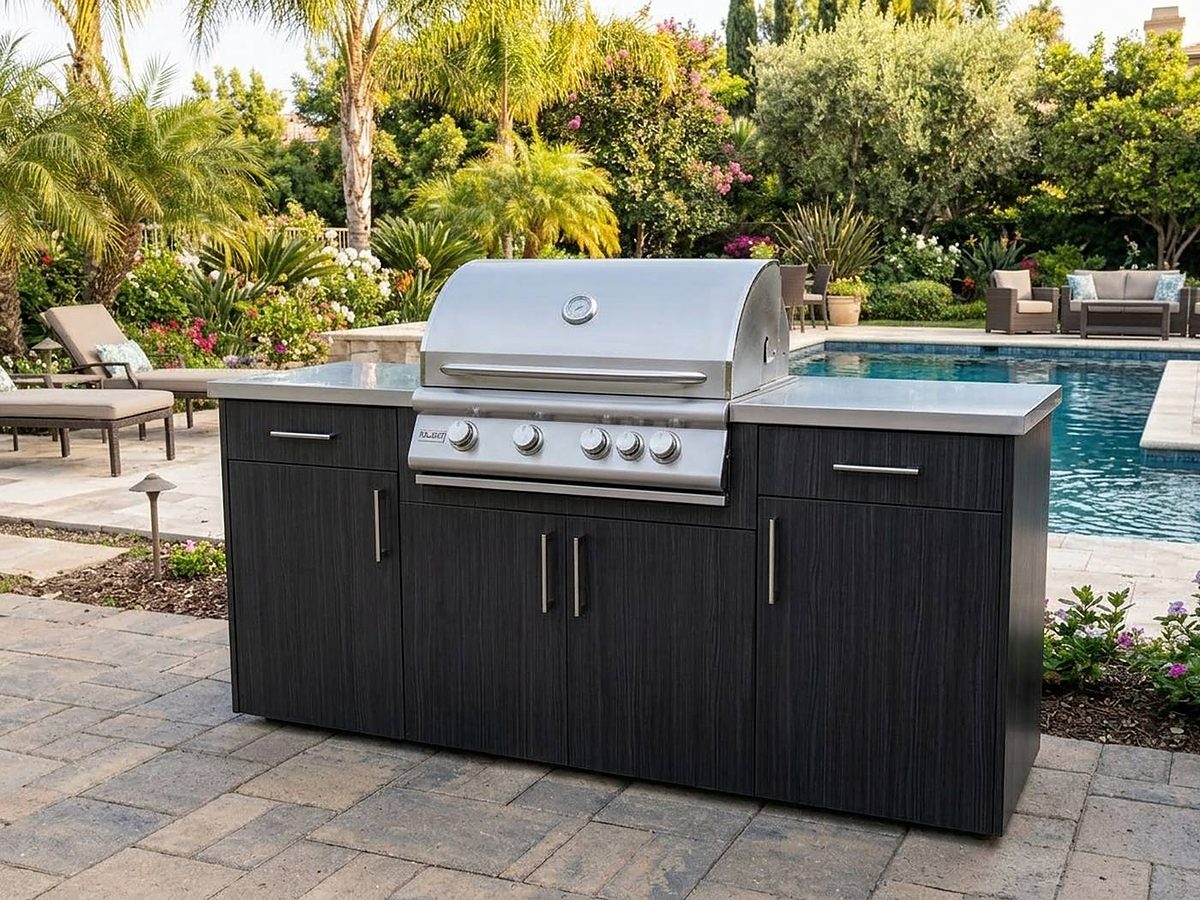
Key takeaways
A backyard kitchen lasts or fails on how the cabinet is built, not on how the doors look in a photograph. Measure the space, compare construction rather than adjectives, and price the whole installation before you choose a manufacturer.
- Measure the patio, the delivery path and the utilities before you order anything.
- Ask how the frame is joined. Welded and bolted are two different products.
- Ask whether the grill needs an insulated jacket, and what one costs.
- Compare customisation, appliance fit, delivery and installation as one package.
- Read the warranty document rather than the warranty page, and find out who answers the phone after delivery.
Start with what the kitchen has to do
Before you compare manufacturers, decide what the kitchen is for. A grill station for two people has different demands than a kitchen that feeds a crowd every weekend. Writing that down first keeps a nice door colour from making the decision for you.
Measure the space, and the route to it
Start with the usable area rather than the whole patio. Record walls, posts, steps, doors, rooflines and drainage, and note what the surface is and whether it slopes. Then measure the delivery path, including gates and tight turns, because a finished cabinet needs more clearance to travel than its footprint suggests.
Photographs and rough dimensions are enough to start a conversation. If you want a structure to follow, our guide to building an outdoor kitchen walks through the same sequence in order.
Pick a layout that matches how you cook
A straight run works well against a wall and keeps everything within reach. An L separates cooking from serving and gives guests a corner to stand in without being in the cook's path. Think through where ingredients are stored, where food is prepared, where hot dishes land, and where people gather.
We build straight runs at 5, 6 and 7 feet and one L at 7 by 4. We do not build U-shapes, islands or freestanding modular pieces, and we would rather say so than quote you something we do not make.
List the appliances before you size the cabinet
Every appliance has a required opening, and openings are not interchangeable between brands. List the grill, side burner, refrigerator, trash pull-out, drawers and doors, then confirm the cutout for each one. Utilities belong in this stage too: the gas source, the electrical outlets, and anything your local code requires.
We fit Blaze only. The 20 inch refrigerator is a BLZ-SSRF20-4.3 at 4.3 cubic feet, and every cutout in the frame is cut for the appliance you chose before the cabinet leaves the jig.
Compare the materials part by part
Outdoor cabinetry has to survive conditions that would destroy most indoor materials. Compare the frame, the doors, the countertop and the hardware separately, because "weatherproof" on its own is not a specification.
The frame: ask whether it is welded or fastened
This is the question that separates the category, and it is the one least often answered on a website. An aluminum frame that bolts together has a fastener in every structural joint, and a fastener is a hole and a moving part. A cabinet on a patio runs a heat cycle every day of its life, expanding through the afternoon and contracting overnight, and before any of that it spends days on a freight truck.
Our frames are aluminum extrusion, cut to your build, squared in a jig and welded corner to corner into one rigid box in our shop in Homosassa. A weld cannot loosen, because once it cools there is no joint left to loosen. Ask any maker to show you a photograph of the bare frame, and see what comes back.
Our frames also ship as bare aluminum, with no powder coat and no paint, and the floor pans are bare too. That is deliberate. A coating is the only thing protecting a coated frame, and coatings fail first at cut edges and drilled holes. Bare aluminum grows its own oxide skin the moment it meets air, and it grows back when you scratch it. Nobody ever sees the frame anyway, because the doors go on and it is never visible again.
Doors and drawers: ask what the colour actually is
With polymer doors, find out whether the colour runs through the material or sits on top of it. A colour that runs through means a scratch shows the same colour underneath. A coating means a chip shows the substrate, and a deep scratch cannot be sanded out at all.
We use two sheet materials, both coloured all the way through. King StarBoard ST is a marine-grade polymer in twelve solid colours. SIMONA Polygrain is an embossed woodgrain HDPE in six: Onyx, Northeastern Walnut, Birch, Susquehanna Grey, Olyphant Oak and Teak. It looks and feels like wood with none of the maintenance, and there is nothing to refinish. If you want the material detail, our HDPE cabinet guide goes into it properly.
Three door styles: Royal is a flat slab, Sago is a 5mm routed frame, and Foxtail is Sago with verticals running the full height of the door.
Countertops
The countertop takes sun, spills, grease, heat and repeated cleaning, so judge it separately from the cabinet. Ask about thickness, edge treatment, seams and what you are meant to clean it with.
Ours are 16 gauge 304 stainless steel, powder coated in your choice of grey or tan. Both are included in the price and there is no upcharge for either. We do not offer bare stainless, because a coated top runs cooler in direct sun and does not show every mark. The bare stainless you will still have is on the Blaze appliances, and that is the surface that wants a conditioner now and then, wiped in the direction of the grain.
One thing worth asking anyone: what sits between the stainless top and the metal frame underneath it. Stainless set straight onto aluminum is what engineers call a galvanic couple, and in salt air it is how aluminum starts to corrode. Ours are bedded on silicone, which bonds the top down and keeps the two metals from ever touching.
How the materials handle sun, water and heat
Durability is a combination of the material and the design around it. Look for published guidance on fading, corrosion, water intrusion and cleaning rather than one lifetime claim. Even a cabinet built for weather is not watertight, so what happens to water that gets in matters more than a promise that none will.
| Exposure | What to ask | What we do |
|---|---|---|
| Sun and UV | Is the finish UV stable, and will the colour shift? | Colour runs through the sheet. We do not cover fading, because nobody honestly can in Florida sun. |
| Rain and humidity | Where does water go if it gets in? | An aluminum pan floor closes out the bottom of every bay, so nothing sits on bare ground and water has somewhere to go instead of somewhere to sit. |
| Heat from appliances | Does the grill need an insulated jacket? | No. The frame around the appliance is welded aluminum and no polymer goes near the opening. |
| Salt air | What separates dissimilar metals? | A silicone bed under the countertop, which bonds and isolates in one bead. |
Construction and the questions worth asking
Material labels only tell part of the story. Ask for construction photographs and care instructions before you place a large order, and ask what the materials do not claim to do. Clear limits are a better sign than a lifetime slogan.
The insulated jacket, and what it costs
Put a grill inside a plastic box and the opening has to be lined with a metal jacket first. That is not our rule about anyone else's cabinets, it is the polymer industry's rule about its own material: marine polymer softens around 180 degrees and a grill runs several hundred. One maker states plainly that a jacket is needed for safety if the kitchen is built from wood, PVC or HDPE. Another voids its warranty outright if a heat appliance goes in without one.
A jacket runs $600 to $1,000 per grill. So ask the question before you compare cabinet prices, because it may not appear in either quote.
Our grills drop straight in. The frame around the appliance is welded aluminum and the polymer on our cabinets is out on the door faces where the weather is, not wrapped around the appliance, so there is nothing combustible next to the fire to protect. Your appliance still arrives with its own installation instructions and those always govern, but there is no jacket to buy.
Ventilation and water
Outdoor kitchens combine heat, gas, water and enclosed storage, so ventilation is a safety matter as well as a durability one. A manufacturer should be able to tell you where the vents are and what they are for. Ours must never be blocked or lined, and that includes not adding an insulating box inside the appliance bay.
Hardware, and the one part that needs you
Open every door and drawer you can get your hands on. Movement should feel even and gaps should be consistent. Then ask the awkward question: what happens to the hinges and slides in five years.
Here is our answer, because you will find it out eventually and we would rather it came from us. The hinges and the drawer slides are the parts that will corrode if they are ignored. They are metal, they live outdoors and they have moving faces, which is the combination that gets any hardware in the end. A silicone spray two or three times a year is the whole job, and it is written into the care guide that ships with every kitchen. No warranty anywhere covers hardware that never got maintained, ours included.
What happens when something gets damaged
Ask what happens if you put a deep scratch across an end panel four years from now. On most cabinets the answer is that you live with it, because when the panel is the structure, a damaged panel is a structural problem.
Every door, drawer face and end panel on our cabinets is screwed to the welded frame from the inside, which is the method the sheet manufacturer recommends, with oversized holes so the polymer can expand and contract freely. Nothing is glued and no fastener shows on any face. So a damaged panel is not a repair, it is a part. We ship you the panel and the instructions and you are done in about twenty minutes with a screwdriver.
Customisation, and what it actually means
Customisation should solve a problem with your space, not add choices to a list. Ask which dimensions can genuinely change, and make sure every custom choice appears on the final quote.
Configured or designed
These are two different services and it is worth knowing which one you are buying. Our configurator prices a kitchen live as you choose layout, size, door style, finish, countertop and appliances, with no email required. That covers our standard sizes. For a project outside them, our custom page explains how that works and who handles it.
Finishes and accessories
Make a finish board before you decide. Put samples beside the patio flooring, the wall colour and the furniture, in shade and in direct sun, because a finish on a screen is not a finish in your yard. Then list accessories by what you will actually use: side burner, refrigeration, drawers, trash pull-out.
Ask for physical samples and confirm whether the same finish will be available on a replacement part years later. We keep both sheet lines in stock for exactly that reason.
Assembly, delivery and installation
The delivery model changes the project more than most buyers expect. Flat-packed cabinets lower freight cost and hand you the assembly, the alignment and the countertop work. A finished unit moves that work to the factory and puts stricter demands on access and lifting.
Assembled means different things
Ask exactly what is included. Ready-to-assemble cabinets arrive as panels, hardware and instructions, and you build and square the boxes before appliances and countertops go anywhere near them.
Ours ship fully assembled with the countertop already installed. Straight runs arrive as one piece. The L arrives in two sections that bolt together on site. Set it, level it, connect the gas, and cook the same day. Most setups take under an hour, and shipping is free in the lower 48.
The delivery path and the pad
Measure the narrowest point between where the truck can stop and where the cabinet has to sit, including gate openings, steps, slopes and turning radius. Confirm whether delivery is curbside or placed. The pad should be finished and stable before the cabinet arrives, with gas and electrical where the plan says they are.
Levelling
A small slope is normal and does not rule out a freestanding cabinet. Every one of ours ships with adjustable leveling feet giving up to 1.5 inches of adjustment. Beyond that, a slope may affect level installation, so measure the pad rather than assuming the feet will fix it.
Gas
This part stays professional whatever you buy. Decide early whether the kitchen runs on natural gas or propane, confirm the connection point, and ask what regulators, hoses and shutoffs are included. Natural gas should be connected by a licensed plumber, and a qualified installer is required for any gas appliance for the Blaze warranty to be in effect. The LP regulator connects to the grill on site: tighten it with a wrench and leak test every joint with soapy water before lighting.
Warranty and support
Read the warranty document, not the warranty page. Check who is covered, how long, whether it transfers, and whether labour and freight are excluded. Then look at the exclusions, because that is where the real position is.
Ours in plain terms: we do not cover fading, because nothing anyone sells can honestly promise a colour will never shift in Florida sun. What we do not do is rule out corrosion altogether, which some of the biggest names in this category do in writing. The exception is hardware that never got maintained, and no warranty anywhere covers that.
Blaze appliances carry their own warranty, separate from the cabinet, and it has a condition worth knowing before delivery day: register each appliance at blazegrills.com within 30 days of purchase and keep your receipt. Blaze covers main burners, cooking grids, body, flame tamers, warming racks and valves for life, and ignition and electronics for a year. It does not cover discolouration or surface rust. Fire table burners are warranted by The Outdoor GreatRoom Company, and because we are your selling dealer that process starts with us.
Who answers the phone
Ask who handles a missing part, freight damage, an appliance problem or a warranty claim, and how you reach them. There is no call centre here and no sales team. You get us, on 352-450-8881, Monday to Friday 8am to 4pm Eastern, or info@fireislands.com. That is either the reason to buy from us or the reason not to, and we would rather you decided having spoken to us.
Seven questions to ask anyone
If you take one thing from this post, take these. Ask us, and ask everyone else you are considering. The answers tell you more than any brochure.
- Is the frame welded, or fastened? Ask to see a photograph of the bare frame.
- Does the grill need an insulated jacket, and what does one cost?
- What carries the countertop, a frame or the panels themselves?
- What is between the stainless top and the metal underneath it?
- If I put a deep scratch in a panel five years from now, what happens?
- What does the warranty actually say about the finish?
- Where is it built, and who owns that building?
We answer all seven on our how it's built page, in order, including the ones that are not flattering.
Compare the whole package, not the cabinet price
Once you have two or three detailed proposals, put them in the same sheet. The lowest number often leaves something out that another quote includes.
- Cabinet dimensions, layout, frame construction, doors, drawers and finish.
- Countertop material, gauge, coating and any upcharge.
- Appliance models, cutouts, accessories and whose warranty covers them.
- An insulated grill jacket, if the cabinet needs one.
- Freight, delivery placement, assembly and section joining.
- Gas, electrical, levelling, pad preparation and who does each.
For what those numbers usually come to, our cost guide breaks down where the money goes. Our own straight runs start at $6,774 and the L at $8,474, complete with the countertop.
Conclusion
Choosing a manufacturer gets much easier when you judge the whole system: the space you measured, the way the frame is joined, what the colour is made of, how the appliance sits in the opening, how it arrives, and who picks up the phone afterwards. Ask the seven questions. Read the warranty document. The finished kitchen is then far more likely to be a part of the backyard rather than an expensive object that creates new problems.
Frequently asked questions
What should I look for in an outdoor kitchen cabinet manufacturer?
Specific material and construction answers rather than adjectives. Ask how the frame is joined, what the door colour is made of, whether the grill needs a jacket, what the warranty excludes, and who handles a problem after delivery.
Are aluminum outdoor kitchen cabinets a good choice?
Aluminum is a strong outdoor frame material and it does not rust like ordinary steel. The thing to check is how it is joined: a welded frame and a bolted frame are two different products, and only one of them has a fastener in every structural joint.
Are HDPE and marine-grade polymer cabinets weather resistant?
Yes, and they are the right material for the job outdoors. What matters is whether the colour runs through the sheet, how the panels are attached, and whether the polymer is anywhere near the appliance, because that is what decides whether the grill needs an insulated jacket.
Should outdoor kitchen cabinets arrive assembled?
Assembled removes the box building, the squaring and the countertop work from your patio. It still needs a prepared pad, a clear delivery route and qualified gas connection. Ask exactly what "assembled" includes, because it is not a standard term.
Do outdoor kitchen cabinets need ventilation?
Yes. Heat and gas both need somewhere to go. Keep the vents clear, do not store anything that blocks internal airflow, and follow both the cabinet and the appliance instructions around grills and burners.
What should an outdoor kitchen warranty cover?
Materials and workmanship, for a stated period, for a stated owner. Then read the exclusions: labour, freight, transferability, finish, corrosion and normal wear. A warranty that excludes corrosion outright is telling you something about the cabinet.
Where are Fire Islands cabinets made?
In Homosassa, on the Florida gulf coast, by Aluminum Outdoor Kitchens LLC. We weld the frames, cut the poly and crate every cabinet ourselves, and we own the building.
Keep reading
Build the one you have been reading about.
Layout, finish, appliances and a live price. Ships fully assembled, free in the lower 48.
Start your build →