304 Stainless Steel Outdoor Kitchens
August 19, 2026
Key takeaways
A 304 stainless countertop is a good decision, but it is one decision out of about six. What sits under it, and what separates it from the metal underneath, matter just as much.
- 304 is the right grade for most residential outdoor kitchens. 316 earns its money within a few miles of surf.
- 16 gauge is a real thickness, but support matters more than gauge, especially around the grill opening.
- Ask what sits between the stainless top and the metal frame. Two dissimilar metals touching is how corrosion starts.
- We powder coat every top grey or tan at no extra cost and do not offer bare stainless.
- Clean stainless with the grain, never across it, and keep uncoated metal off it.
What 304 stainless actually gives you
304 contains enough chromium to form a passive layer on the surface, which is what slows corrosion. That is why it turns up in commercial kitchens and on boats: it is strong, it cleans easily, and it stays serviceable through hard use.
It is not rust-proof under every condition, and it is worth knowing why. Salt, standing water, harsh chlorine products and iron contamination can all mark it. Most of what people call "rusty stainless" is contamination sitting on the surface rather than the steel itself failing, and it usually cleans off.
304 or 316, and how to actually decide
316 adds molybdenum, which improves resistance to chlorides. So the honest answer is that it depends on where you live rather than on higher being better.
Near the coast, 304 can develop what the trade calls tea staining: a light brown discolouration on the surface that is cosmetic and cleans off, but keeps coming back if the salt keeps landing. The stainless industry's own standards body recommends stepping up to the marine grade within a few miles of surf. Away from that, on a covered patio, with an ordinary wipe-down routine, 304 is a balanced specification and the one we build.
If your house is directly on the water, say so when you are getting quotes and ask what grade is being offered, because it changes the answer.
What 16 gauge means, and what it does not
Gauge is thickness, and a lower number is thicker. 16 gauge is substantial enough that the top does not flex when you lean on it or set down a loaded tray. Ours are 16 gauge 304.
But gauge alone tells you very little. What holds the sheet up decides how it feels: the support beneath it, the seams, the edge construction and how the cutouts are finished. Ask how the countertop is supported around the grill opening and across any long unsupported span, because that is where a thin-feeling top gives itself away.
The question almost nobody asks
Here is the one worth taking to every maker you talk to. What sits between the stainless top and the metal frame underneath it?
A stainless countertop set straight onto an aluminum frame is what engineers call a galvanic couple, and in salt air it is one of the ways aluminum starts to corrode. The military standard for joining dissimilar metals asks for two things: a barrier between the surfaces, and a seal so moisture cannot get into the joint.
Our tops are bedded on silicone, which does both with one bead. It bonds the top to the frame and it keeps the two metals from ever touching. It is also why you should never try to lift, shim or reseat one of our countertops, and why it is worth calling us if that bead is ever cut or pulls away along an edge.
The countertop is not the cabinet
A stainless top can be excellent while the cabinet under it fails from swelling, rot, corrosion or bad drainage. Judge the whole assembly: frame, doors, fasteners, floor pans, vents and feet.
Welded aluminum, and why it is not the same as steel
Aluminum avoids the rust problem that comes with ferrous steel, and it does not swell or rot. What matters as much as the metal is how it is joined. A frame that bolts together has a fastener in every structural joint, and a cabinet on a patio runs a heat cycle every day of its life, expanding through the afternoon and contracting overnight. Fasteners are the part that answers to all of it.
Ours are aluminum extrusion, cut to your build, squared in a jig and welded corner to corner into one rigid box. Not bracketed and not bolted. A weld cannot loosen, because once it cools there is no joint left to loosen. Ask any maker to show you a photograph of the bare frame and see what comes back. Ours is on the how it's built page.
The frame also ships bare, with bare pan floors, no powder coat and no paint. That is deliberate: a coating is the only thing protecting a coated frame, and coatings fail first at cut edges and drilled holes. Bare aluminum grows its own oxide skin and grows it back when scratched.
Polymer doors, and how they are attached
Our doors and drawers are marine-grade HDPE, coloured all the way through: King StarBoard ST in twelve solid colours or SIMONA Polygrain in six embossed woodgrains. Nothing to rot, nothing to refinish.
How they are attached matters more than people expect. Every panel is screwed to the welded frame from the inside, through oversized holes so the polymer can expand and contract freely, which is the method the sheet manufacturer recommends. Nothing is glued and no fastener shows on any face. That is also why a deep scratch across an end panel is a part rather than a repair: we ship you the panel and the instructions and you are done in about twenty minutes with a screwdriver.
Water and ventilation
Weather resistance is not watertightness. Heavy rain can put some water in through door gaps on any outdoor cabinet. Every one of ours has an aluminum pan floor that closes out the bottom of each bay, so nothing sits on bare ground and water has somewhere to go instead of somewhere to sit.
Ventilation is the safety half of this. Vents must stay clear, storage must not be packed against them, and the appliance bay must never be lined with foil, board or anything else.
Finish, and the choice we do not offer
Why every top we build is powder coated
Bare stainless has the familiar commercial-kitchen look, and its grain hides small marks when you clean in the same direction. The trade-offs are that it gets hot in direct sun and shows water spots and fingerprints.
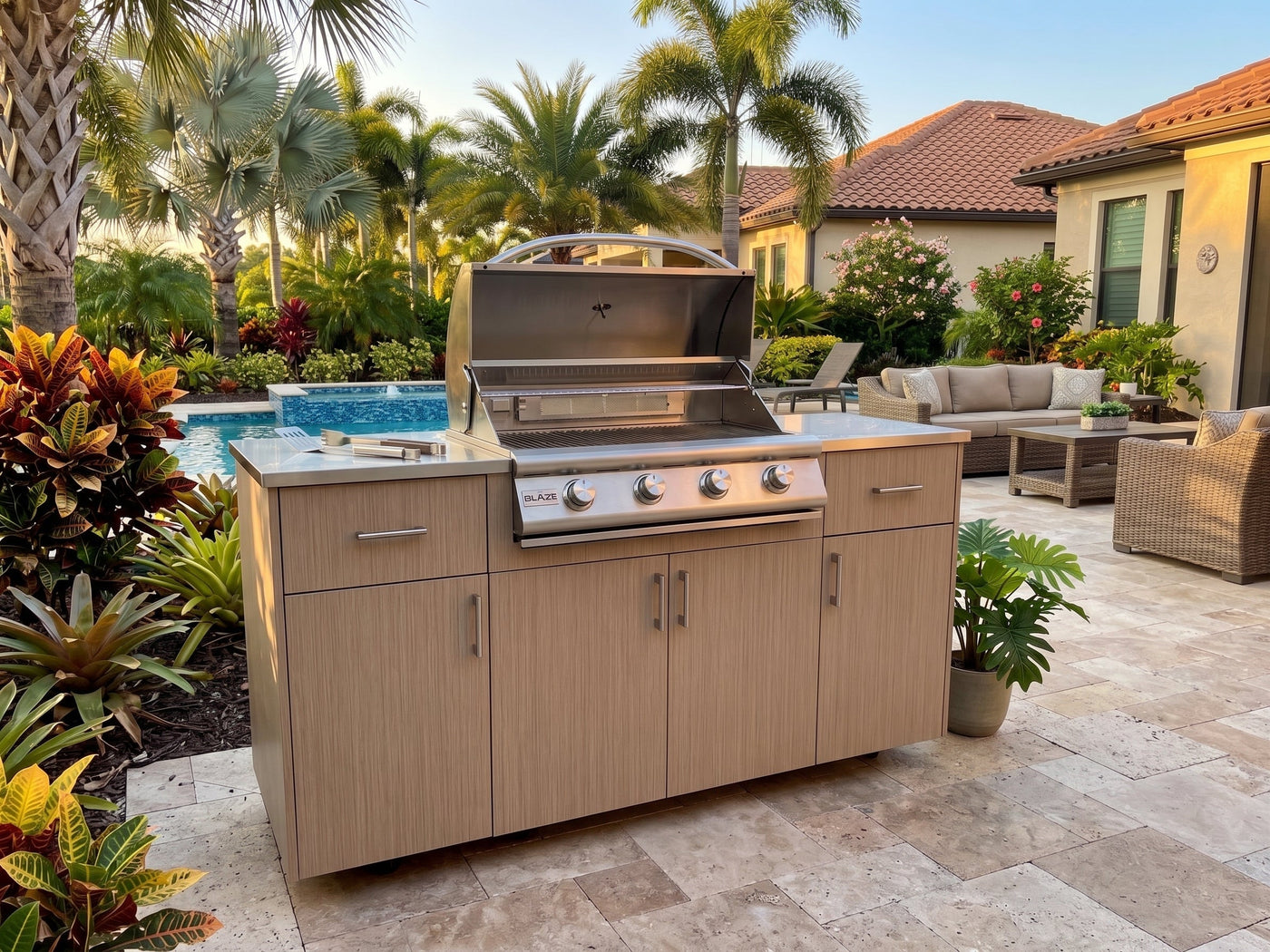
We powder coat every top we build, in grey or tan, and both are included in the price with no upcharge for either. We do not offer bare stainless. A coated top runs cooler in direct sun and does not show every mark, and after enough Florida summers that turned out to be the choice worth making for people rather than the choice that photographs best.
The bare stainless you will still have is on the Blaze appliances: the grill face, the fridge door and the drawer fronts. That is the surface that wants the classic treatment.
Layouts
A straight run is efficient against a wall or along the edge of a patio. An L creates a corner work zone and separates cooking from serving, but it needs room for people to pass. We build straight runs at 5, 6 and 7 feet and one L at 7 by 4. We do not build U-shapes, islands or freestanding modular pieces.
Think in work zones rather than cabinets. Put refrigeration where guests can reach it without crossing the cooking area, and leave a landing surface beside the hot appliance. Our configurator prices any combination live as you choose it.
Measuring
Measure the usable area, not the whole patio. Record walls, posts, railings, doors, steps, roof supports and changes in floor height. Then measure the route from where the truck can stop to where the cabinet has to sit.
- Mark the total width and depth available.
- Note appliance openings, utility locations and anything combustible nearby.
- Reserve space for doors, drawers, people and furniture.
- Measure the narrowest point of the delivery path and any overhead limit.
Then compare against the actual assembled dimensions rather than the product name. A few inches decides whether a finished unit clears a gate.
Appliances and gas
Pick the appliances while the layout is still on paper, not after the frame is cut.
Blaze, and why the openings are cut first
We fit Blaze only: grills, side burners and outdoor refrigeration. The 20 inch refrigerator is a BLZ-SSRF20-4.3 at 4.3 cubic feet. Every cutout in the frame is made for the appliance you chose before the frame leaves the jig, which takes the guesswork out of cutout dimensions.
A grill still needs landing space, a side burner needs room for a pan, and a refrigerator needs a door swing that does not hit a drawer or a walkway. A trash slide-out and an LP tank slide-out are standard in every kitchen we build.
No insulated jacket
Worth asking about before you compare prices, because it will not be in the cabinet quote. Put a grill inside a polymer box and the opening has to be lined with a metal jacket first, which is the polymer industry's own rule about its own material. That runs $600 to $1,000 per grill.
Our grills drop straight in. The frame around the appliance is welded aluminum and the polymer is out on the door faces where the weather is, not wrapped around the appliance, so there is nothing combustible next to the fire to protect. Your appliance instructions still govern.
Natural gas or propane
Both work. Natural gas needs a correctly sized permanent line; LP needs tank access for inspection and replacement, which is what the built-in slide-out is for. Plan the route, the shutoff and the ventilation as part of the installation rather than at the appliance.
Gas is where a placement project becomes regulated work. Natural gas should be connected by a licensed plumber, and qualified installation is required for any gas appliance for the Blaze warranty to be in effect. The LP regulator connects to the grill on site: tighten it with a wrench and leak test every joint with soapy water before lighting. If it is unclear, stop and ask a professional rather than improvising fittings.
Delivery and installation
What fully assembled means here
Ours arrive with the cabinet built and the countertop already installed, so nobody is sorting panels and brackets on the patio and the alignment between frame, doors, top and appliance openings is already set. Straight runs arrive as one piece. The L arrives in two sections that bolt together on site.
Confirm the section count and the handling before delivery day so the right number of people are there. Freight is free in the lower 48.
The pad and the feet
Set it on a firm, stable, reasonably level surface, swept clear, with water able to move away from the base rather than collect under it. Every cabinet ships with adjustable leveling feet giving up to 1.5 inches of adjustment, which covers most patio slopes. Beyond that, the base needs addressing rather than the feet.
Adjust gradually and check the top in more than one direction. A level cabinet is what makes doors close properly and keeps appliances seated.
Moving it the last few feet
Walk the route in advance, measure gates and corners, and decide where the cabinet will rest while the final position is prepared. Do not drag it across finished paving, keep hands out of pinch points, and check the destination is ready before unloading.
Looking after a stainless top
Bare stainless, with the grain
For the Blaze appliance surfaces: let it cool, then wipe with mild soap, water and a soft cloth, following the direction of the grain rather than scrubbing across it, and dry to reduce water spots. A stainless conditioner periodically helps preserve the look.
Avoid steel wool, abrasive powders and harsh chlorine products. They scratch the finish or leave contamination that shows up later as rust-coloured marks. Test any unfamiliar cleaner somewhere out of sight.
Powder coated tops
Mild soap and warm water after each use, dried with a soft cloth to prevent water spots and mineral deposits. A light coat of car wax or a powder coat protectant once or twice a year maintains the finish. The coating is the visible finish, so do not drag sharp or heavy things across it, and use a trivet for hot cookware.
It stays cooler than bare metal in the sun but it does not stay cool. Use some judgement about what you put down on a surface that has been baking all afternoon.
Preventing the marks that are hard to remove
- Wipe grease off the top and the cabinet faces once things have cooled, especially around handles and drawer edges.
- Dry stainless and powder coated surfaces after washing.
- Keep abrasive pads, steel wool and uncoated rusty metal off every finish.
- Take leaves, berries and tree sap off promptly if the kitchen sits near planting.
The one part that needs you
Everything above is a surface that looks after itself. The hinges and the drawer slides do not. They are metal, they live outdoors and they have moving faces, and left dry they will corrode, then stiffen, and eventually seize.
A silicone-based spray on every hinge and slide two or three times a year is the whole job, more often near salt water. Hardware that seizes from lack of lubrication is wear from neglect and no warranty covers it, ours included. They are screwed-in parts, so if one wears out we send you a replacement. Our care and protection guide covers the full routine.
Standard sizes or a custom build
When a standard run is the right answer
Five, six and seven foot straight runs cover most open walls and patio edges, and they give you a grill, a side burner, refrigeration and storage with no masonry and no design process. A straight run is also simpler to deliver and to move later.
Take the largest size that leaves comfortable circulation rather than the largest that fits. A compact kitchen that works beats a long one that turns the patio into a corridor.
When the space needs more
Angled walls, structural columns, multiple elevations or an existing bar or fire feature are the cases where standard dimensions start costing you compromises. Our custom page explains how that route works.
Comparing the whole project
Price the pad, the utility work, delivery access, appliances, an insulated jacket if the cabinet needs one, and professional gas connection, not just the cabinet. Our straight runs start at $6,774 and the L at $8,474, complete with the countertop and free freight in the lower 48. The cost guide breaks down where the money usually goes.
Read the cabinet and appliance warranties before ordering, and handle appliance registration promptly: Blaze appliances must be registered at blazegrills.com within 30 days of purchase. Blaze covers main burners, cooking grids, body, flame tamers, warming racks and valves for life, and ignition and electronics for a year, and it does not cover discolouration or surface rust.
Conclusion
Choosing a 304 stainless outdoor kitchen comes down to matching the grade to your distance from salt, the gauge to how the top is supported, and the countertop to what is underneath and between. Ask what separates the stainless from the frame, ask how the frame is joined, and ask whether the grill needs a jacket. Then measure the delivery path. That sequence gets you a kitchen that still looks right in ten years.
Frequently asked questions
Is 304 stainless steel suitable for an outdoor kitchen?
Yes, and it is the standard for good reason: useful corrosion resistance, real strength and easy cleaning. It is not rust-proof, and salt, standing water and iron contamination can still mark it, most of which cleans off.
Is 316 better than 304 for a coastal home?
316 resists chlorides better, so it is worth considering within a few miles of surf, which is what the stainless industry's own guidance suggests. Further inland, or under cover, 304 with a normal wipe-down routine is a balanced choice.
What is tea staining?
A light brown surface discolouration that shows up on stainless near the coast. It is cosmetic rather than structural and it cleans off, but it returns while the salt keeps landing, which is the argument for the upgraded grade close to the water.
Does 16 gauge make a strong countertop?
It is a genuinely substantial sheet, but support decides how it feels. Ask about the structure under it, the seams, the edge construction and how the grill cutout is finished.
Do you offer bare stainless countertops?
No. Every top we build is 16 gauge 304 powder coated grey or tan, both included at no extra cost, because a coated top runs cooler in the sun and shows fewer marks. The bare stainless in your kitchen is on the Blaze appliances.
Can an outdoor kitchen be completely waterproof?
No outdoor cabinet is watertight. Some water can enter during heavy rain, which is why ours have an aluminum pan floor to give it somewhere to go, and why wiping out standing water is part of the routine.
Can homeowners install one themselves?
You can prepare the pad, position the cabinet, level it on the feet and complete ordinary setup. The gas connection should be done by a licensed plumber or qualified installer, which is also a condition of the appliance warranty.
How often should a stainless outdoor kitchen be cleaned?
Wipe surfaces whenever grease or residue appears, which usually means after cooking. Add a seasonal look at hardware, vents, the cabinet interior and the visible connections, and lubricate the hinges and slides two or three times a year.
Keep reading
Build the one you have been reading about.
Layout, finish, appliances and a live price. Ships fully assembled, free in the lower 48.
Start your build →